
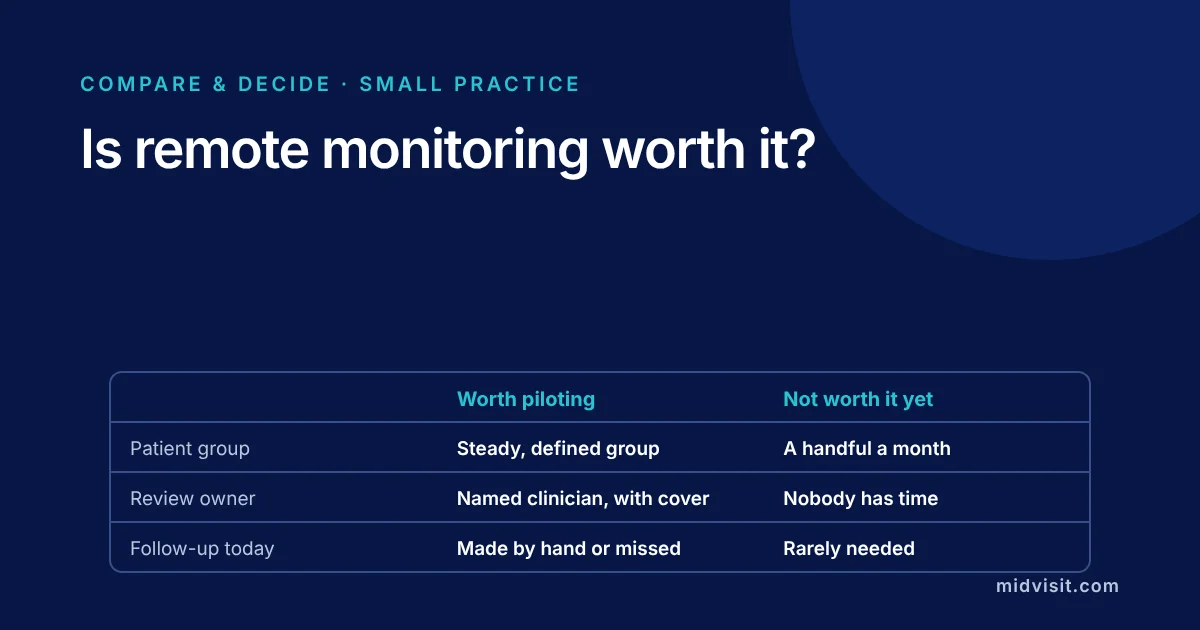
Remote patient monitoring for a small practice is worth it when a defined patient group already needs contact between appointments, a named clinician can review flagged responses, and the tool replaces calls staff make or miss. It is rarely worth it for very low volumes, with no review owner, or when the case relies on US billing income.
Small practices hear a lot of promises about remote monitoring. Most come from vendors, and many are written for US practices that can bill for it. This guide gives UK private clinics an honest way to decide, including when the answer is no.
It is written for owners, clinical leads and practice managers weighing up a first step. When you are ready to see how one pathway would work in your clinic, you can book a demo with your own patient group in mind.
Is remote patient monitoring worth it for a small practice?
Sometimes. It is worth it when it takes over contact your team already makes, or should be making, for a defined group of patients. It is not worth it when it adds a new layer of work that nobody has time to review.
Much of the online advice on this question is written for US practices, where monitoring can be billed to insurers. UK private clinics should not build a case on that model. Here the case rests on three things: staff time, patient experience and safety-netting between appointments.
This guide gives you an honest way to decide, including the situations where the answer is no.
What does remote monitoring really cost a small practice?
The subscription is only part of the cost. For a small team, the hidden costs are usually time: setting up, reviewing and dealing with patients who do not answer.
- Set-up time. Someone has to agree the pathway, questions, alert criteria and patient information with your clinicians.
- Governance. The ICO says a data protection impact assessment (DPIA) is required for processing likely to result in a high risk, and is more likely to be needed for health data (ICO: when do we need to do a DPIA?).
- Review time. Every flagged response needs a named clinician to look at it, including during leave.
- Unanswered contacts. Missed calls or unread messages still need a decision about what happens next.
- Devices, if used. Supplying, setting up and replacing equipment adds logistics.
Alert volume is the cost small practices most often underestimate. Device-based monitoring that streams readings can generate far more alerts than a team expects, and alert criteria are what keep that manageable. Continuous device monitoring is a different model from scheduled check-ins, but the lesson holds: alert criteria decide your workload.
What can a small practice realistically expect?
Expect better contact and earlier visibility of some problems. Do not expect proof that it cuts admissions or complications in your clinic.
A systematic review of nurse-led telephone follow-up after discharge found patient satisfaction was one of the strongest positive outcomes. The results did not support improvements in readmission or mortality (nurse-led post-discharge telephone follow-up, systematic review).
The PVC-RAM-1 trial of 905 adults after non-elective surgery found no significant difference in days alive at home. Monitoring did improve the detection and correction of medication errors and reduced pain (PVC-RAM-1, The BMJ, 2021).
A 2025 meta-analysis found remote monitoring probably reduced hospital admissions, mainly in heart disease and COPD, but probably increased outpatient visits. The certainty of the evidence was low (JMIR mHealth and uHealth, 2025). An overview of systematic reviews also stressed that it matters whether monitoring replaces face-to-face contact or is added on top of it (overview of systematic reviews on remote monitoring).
That last point matters most for a small practice. If monitoring is added on top of everything you already do, it costs more. If it replaces calls your team makes by hand, it can free time.
When is remote monitoring worth it for a small practice?
In our view, it is likely to be worth piloting when most of these are true:
- You have a defined patient group that needs contact between appointments, such as patients after a common procedure.
- Your team already makes follow-up calls, or knows it misses some.
- A named clinician can review flagged responses within an agreed time, with cover for leave.
- Your clinicians can agree the questions, timing and alert criteria for that group.
- You have the capacity to complete a DPIA and write clear patient information.
- You can run a time-limited pilot and stop if it does not work.
If these are in place, a short pilot is the safest next step. Our guide on how to run a 90-day remote monitoring pilot sets out scope, governance and review points.
When is remote monitoring not worth it?
Be honest about these signs. Any one of them is a good reason to wait.
- Very low volume. If only a handful of patients a month need contact, a well-organised manual call list may be simpler.
- No review owner. Monitoring without someone to act on flags creates risk, not safety.
- No clear clinical need. If patients rarely need contact between appointments, there is little to replace.
- The wrong goal. If the case depends on new income from billing, the US model does not transfer.
- Patients who cannot use the method. NHS England's guidance on digital inclusion in general practice is a reminder that not every patient can use apps or online tools (NHS England: supporting digital inclusion in general practice). Choose a contact method your patients can actually use.
- No time for governance. If you cannot complete a DPIA and agree patient information now, wait until you can.
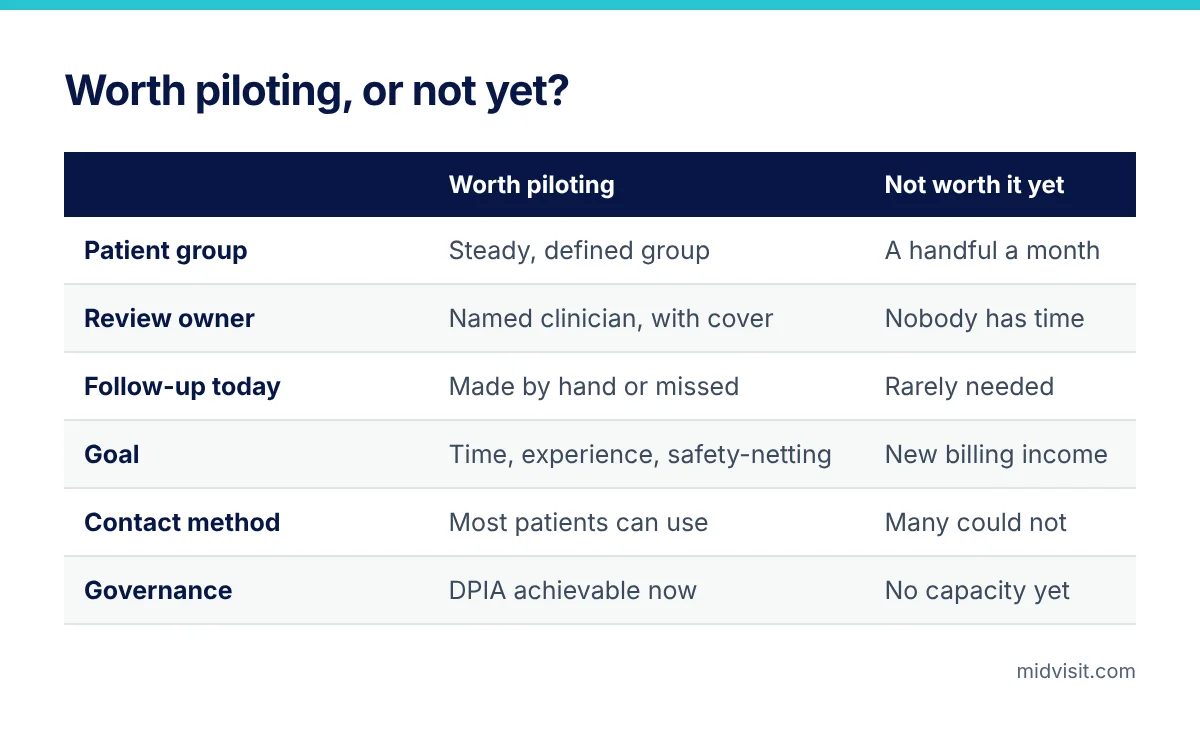
Decision table: should your practice pilot remote monitoring?
Use this table with your clinical lead and practice manager. If most answers sit in the right-hand column, it is not worth it yet.
| Question | Signs it is worth piloting | Signs it is not worth it yet |
|---|---|---|
| Which patients need contact between appointments? | A steady, defined group | A handful a month, or nobody in particular |
| Who reviews flagged responses? | A named clinician, with cover | Nobody has time |
| What happens to follow-up today? | Calls are made by hand, or missed | Rarely needed |
| What is the goal? | Staff time, patient experience, safety-netting | New billing income |
| Can patients use the contact method? | Yes, most of the group | Many could not |
| Can you do the governance now? | DPIA and patient information achievable | No capacity this quarter |
How to estimate the staff time you spend now
Before comparing prices, measure what manual follow-up costs you today. This simple formula uses your own numbers.
Monthly staff cost of manual follow-up = patients per month × calls per patient × minutes per call ÷ 60 × hourly pay.
Count the full time per call: dialling, retries, the conversation and writing it up.
Illustrative example. These inputs are assumptions for the example, not benchmarks:
- 40 patients a month need follow-up (assumption).
- Three calls per patient (assumption).
- 12 minutes per call, including retries and notes (assumption).
- Hourly pay of £16.40, the 2026/27 Agenda for Change Band 5 entry rate in England (NHS Employers pay scales 2026/27).
That gives 40 × 3 × 12 = 1,440 minutes, or 24 hours a month. At £16.40 an hour, that is £393.60 a month in basic pay. It excludes employer on-costs, overheads and your actual pay rates.
Now compare that with a tool's price plus the time it still needs: reviewing flags, handling unanswered calls and governance. Our cost comparison of manual and automated patient follow-up takes this further.
What to do if it is not worth it yet
Not yet is a useful answer. You can still improve contact between appointments without new software.
- Make sure every patient leaves with written advice and a named contact.
- Keep a simple manual call list for the patients who need contact most.
- Make it easy for patients to get in touch themselves. Our guide to patient-initiated follow-up explains how that model works.
- Log follow-up time for a month, so you have real numbers next time.
If you later compare tools, our guide to AI voice calls versus SMS reminders sets out the trade-offs between contact methods.
How Midvisit helps
Midvisit is an AI patient follow-up platform for private clinics. Its voice agent, Mira, calls patients between appointments and flags concerns for clinician review after each call. For a small practice, the starting point is one agreed pathway, such as post-procedure check-in. The clinic decides patient suitability, consent, call timing and review ownership.
Mira phones patients and asks the structured questions set by the configured pathway. Because it is a phone call, patients do not need an app or a device. Each call produces an outcome, duration, transcript and AI-generated summary, and unanswered calls stay in the call history. Responses that meet the clinic's alert criteria are routed to assigned clinicians after the call, and the reviewing clinician can call the patient back from the alert.
Midvisit does not send SMS, connect to clinical record systems or provide emergency monitoring. Clinical decisions stay with your team, as set out in our clinical oversight approach.
FAQs
Is remote patient monitoring worth it for a small practice?
It can be, when a defined patient group already needs contact between appointments, a named clinician can review flagged responses, and the tool replaces calls your team makes by hand. It is rarely worth it for very low volumes, when nobody can review alerts, or when the business case depends on US-style billing income that does not apply to UK private clinics.
Does remote monitoring reduce hospital admissions?
The evidence is mixed. A 2025 meta-analysis found a probable reduction in hospital admissions, mainly in heart disease and COPD, alongside a probable increase in outpatient visits, with low-certainty evidence. A review of nurse-led telephone follow-up found better patient satisfaction but no support for lower readmission or mortality. A small practice should not build its case on admission reductions.
What is the biggest hidden cost of remote monitoring?
Usually staff time, especially reviewing alerts. Alert criteria decide how many flags the team sees. Continuous device monitoring can produce many alerts unless criteria are set carefully. Scheduled check-in calls work differently, but review time still needs planning before you start.
How many patients does a practice need to make monitoring worthwhile?
There is no published threshold. Instead, measure your current follow-up workload: patients per month, calls per patient and minutes per call. If the total is small and well handled, a manual call list may be enough. If calls are frequent, time-consuming or often missed, a time-limited pilot can show whether automation helps.
Do patients need apps or devices for remote monitoring?
Not always. Remote monitoring can use connected devices, app questionnaires or phone calls. Devices add supply and set-up work, and apps rely on patients being able and willing to use them. Phone-based check-ins avoid both, though they still need clear patient information, agreed timing and a plan for calls that go unanswered.
Does a small practice need a DPIA for remote monitoring?
Very likely. The ICO says a data protection impact assessment is required before processing that is likely to result in a high risk, and that one is more likely to be needed for health data. Practice size does not change that test. Allow time for the DPIA in your plans, and ask any supplier for the documents you will need to complete it.
Should a small practice run a pilot first?
We recommend it. A time-limited pilot with one patient group, one clinical lead and agreed success measures lets you test answer rates, alert volume and staff time before committing. Write down in advance what would make you stop, adjust or extend, so the decision at the end rests on evidence.