
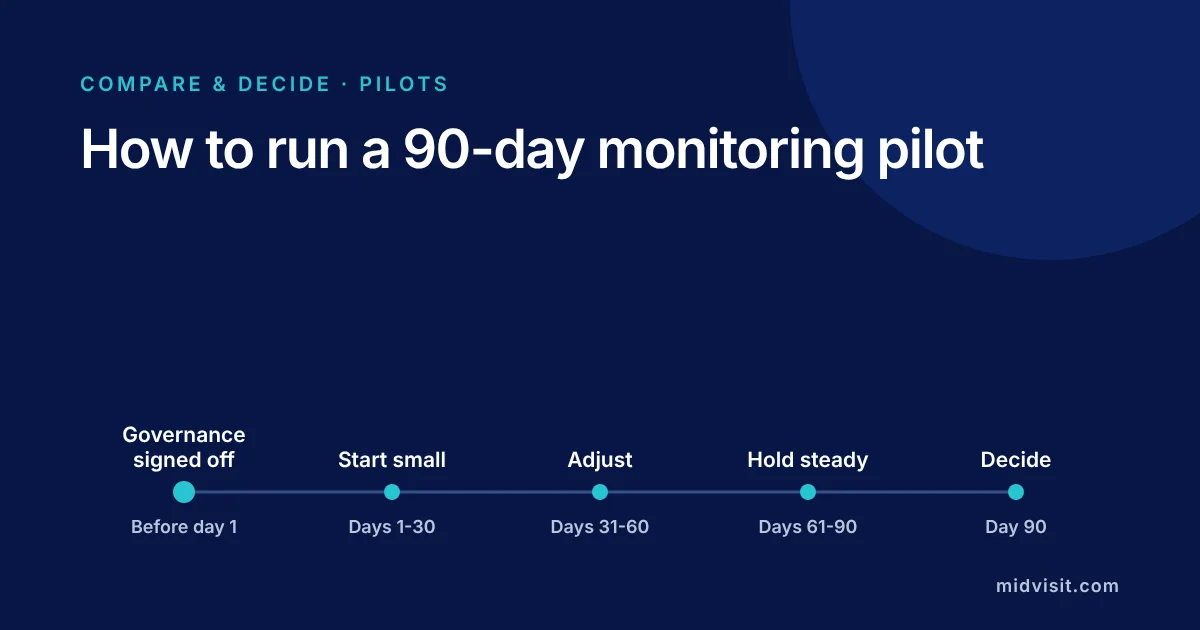
A remote patient monitoring pilot is a time-limited test of whether structured contact between appointments works for one patient group. In 90 days, a UK private clinic can scope one pathway, finish its governance before the first call, measure answer rates, alerts and staff time, and then decide whether to stop, adjust or extend.
Most remote monitoring pilots that stall do so for the same reasons: no agreed scope, governance done in a hurry and no decision point. This guide sets out a 90-day plan for UK private clinics that puts governance first and ends with a clear decision.
It is written for owners, clinical leads and practice managers. If you would rather walk through a pilot workflow with us, you can book a demo to see how a pilot runs. Nothing here describes Midvisit pilot terms, which are agreed separately with each clinic.
What is a remote patient monitoring pilot?
A remote patient monitoring pilot is a time-limited, small-scale test of structured contact with patients between appointments. It answers one question: does this work for this patient group, with this team, well enough to keep going?
A pilot is not a soft launch. It has a fixed scope, an end date, agreed measures and a decision at the end. Without those, a pilot tends to drift into a permanent service that nobody formally chose.
We recommend 90 days as a working length for a first pilot. It is long enough to see a few hundred contacts in most clinics and short enough to stop cleanly. The number is a planning choice, not a standard, and your pilot can be shorter or longer.
What governance should be in place before the first call?
Governance comes first because a pilot still involves real patients and real health data. Most of the work happens before day 1, and most of it belongs to the clinic, not the supplier.
A data protection impact assessment (DPIA)
The ICO says you must carry out a DPIA before processing that is likely to result in a high risk, and that you are more likely to need one when processing special category data such as health information (ICO: when do we need to do a DPIA?). A remote monitoring pilot collects health information about patients at home, so plan on doing one.
A lawful basis, separate from patient agreement
UK GDPR needs both an Article 6 lawful basis and an Article 9 condition for health data. For health care, the ICO points to the Article 9(2)(h) condition, used under the responsibility of a professional bound by confidentiality (ICO: conditions for processing special category data). The ICO also says consent is often not the appropriate lawful basis in a healthcare context (ICO: when is consent appropriate?).
That does not remove the need to explain the pilot to patients. A patient agreeing to be called is a care decision. The lawful basis for the data is a separate question for your data protection lead.
Clinical safety
NHS England describes two clinical risk management standards: DCB0129 for manufacturers of health IT, and DCB0160 for the organisations that deploy and use it (NHS England: review of DCB0129 and DCB0160). DCB0160 work usually produces a hazard log, a clinical safety case and a named clinical safety officer (CSO).
The standards are written for NHS-funded care. If your clinic does no NHS work, ask your advisers whether DCB0160 formally applies. Its structure is still a practical way to think through what could go wrong and who owns each risk.
How do you scope a 90-day pilot?
Scope narrowly: one patient group, one clinical lead and one reviewing team. A narrow pilot produces clean answers. A broad one produces noise and a tired team.
We recommend choosing a group that already needs contact between appointments and has a fairly predictable course. Patients after a common procedure are a typical example, as described in our guide to post-operative remote monitoring in the first 14 days. Avoid starting with your most complex or highest-risk patients.
Write the scope on one page. Name the patient group, the expected number of patients, the start and end dates, the people involved and the questions the pilot must answer.
Clinical choices inside the pilot belong to your clinical team. Who is suitable, when to call and what counts as an alert are not decisions a supplier should make for you.
Which success measures should a pilot track?
Track measures that a 90-day pilot can actually show: whether patients answer, whether alerts are useful, whether reviews happen on time and how much staff time it takes. Set the targets before day 1.
| Measure | What it tells you | How to collect it |
|---|---|---|
| Answer rate | Whether patients engage with the contact method | Answered calls divided by scheduled calls |
| Completion rate | Whether calls collect what the pathway needs | Calls with all questions answered |
| Alert volume | Whether alert criteria are set sensibly | Alerts per patient over the pilot |
| Alerts acted on | Whether alerts point to real issues | Reviewer notes on each alert |
| Review time | Whether the team can keep up | Time from alert to review note |
| Staff time | The real workload, including unanswered calls | A simple weekly time log |
| Patient feedback | Whether patients find contact helpful | A short survey or call at the end |
Be careful with clinical outcome targets. A 2025 meta-analysis of remote monitoring in noncommunicable diseases found a probable fall in hospital admissions, mainly in heart disease and COPD, alongside a probable rise in outpatient visits. The certainty of the evidence was low (JMIR mHealth and uHealth, 2025).
In our view, a 90-day pilot in one clinic is far too small to show changes in admissions or complications. Operational measures and patient feedback are the honest targets.
What does a 90-day pilot plan look like?
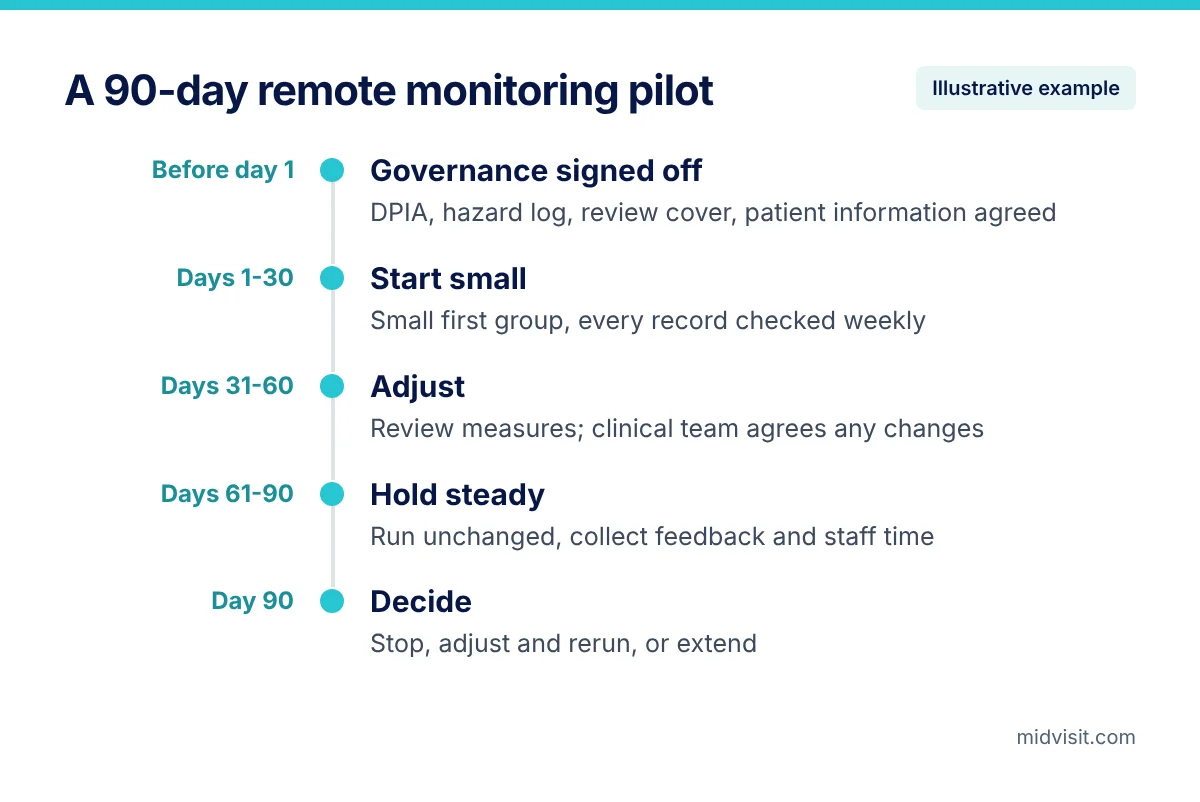
A 90-day plan works best in four blocks: preparation before day 1, then three 30-day blocks, each ending in a short review. This is our operational recommendation, not a clinical schedule.
Before day 1: preparation
- Complete the DPIA, hazard log and data processing agreement.
- Agree pathway content, alert criteria and review cover with your clinical team.
- Write patient information and train the reviewing team.
- Run test calls with staff, not patients, and fix what is unclear.
Days 1 to 30: start small
- Enrol a small first group and check every call record.
- Hold a weekly 15-minute huddle on alerts, missed calls and patient questions.
- Log any incident or near miss in the hazard log.
Days 31 to 60: adjust
- Review answer rates and alert volume against your targets.
- Ask your clinical team whether any alert criteria or question wording should change.
- Enrol the rest of the planned group if the first 30 days went well.
Days 61 to 90: steady state and decision
- Run without changes so the measures are stable.
- Collect patient feedback and a staff time log.
- Prepare a two-page report for the day-90 decision.
How should you decide at day 90?
Decide against criteria you wrote before day 1. There are three honest outcomes: stop, adjust and rerun, or extend. Each is a valid result.
| Decision | Typical signs | Next step |
|---|---|---|
| Stop | Low answer rates, alerts the team does not trust, or reviews regularly missed | Close the pilot, tell patients, keep the records you must keep |
| Adjust and rerun | Patients engage, but alert criteria, timing or workload need work | Change one or two things and run a shorter second phase |
| Extend | Targets met, the team keeps up, patients find it useful | Update the DPIA and hazard log, then add one more group |
Stopping is not failure. A pilot that shows a pathway is not right for your clinic has saved you a longer, costlier mistake. Record what you learned either way.
What should you ask a vendor before a pilot?
Ask for evidence, not adjectives. A good supplier will answer these questions in writing before you enrol a patient.
In its virtual ward procurement guidance, NHS England treats compliance with the Digital Technology Assessment Criteria (DTAC) and the DCB0129 standard as must-haves for remote monitoring platform suppliers (NHS England: selecting a technology platform). That guidance is written for NHS systems, but it is a sensible bar for private clinics too. DTAC covers clinical safety, data protection, technical security, interoperability, and usability and accessibility. It also says a supplier's clinical safety officer should be a registered clinician trained in clinical risk management (NHS England: DTAC assessment criteria).
- Which features are live today, and which are on a roadmap?
- What clinical safety and data protection documents can you share?
- Where is data stored, who can access it and how long is it kept?
- What happens to unanswered or interrupted calls?
- What does the reviewing clinician see after each contact?
- Are pilot price, length, support and exit terms written into the agreement?
Compare suppliers on the same questions. Our guide to manual versus automated patient follow-up costs can help you weigh the answers against your current workload.
How do you explain the pilot to patients?
Tell patients plainly what will happen, who will contact them, what happens to their answers and how to stop. The GMC says doctors must give patients the information they want or need to make a decision, including the options and their benefits, risks and uncertainties (GMC: decision making and consent).
For an AI voice pilot, we recommend covering five points in writing and at enrolment:
- The call comes from an automated voice agent working for the clinic, not a person.
- What the call will ask about and roughly when it will come.
- That a clinician reviews flagged answers after the call, not during it.
- That the call is not an emergency service, and what to do in an emergency.
- How to opt out at any time without affecting their care.
If you are planning the calls themselves, our post-operative check-in call protocol covers identity checks, call structure and unanswered calls.
How Midvisit helps
Midvisit is an AI patient follow-up platform for private clinics. Its voice agent, Mira, calls patients between appointments and flags concerns for clinician review after each call. A pilot starts with one agreed pathway. The clinic decides patient suitability, consent, call timing and review ownership before any patient is enrolled.
During a pilot, Mira makes scheduled, manual or alert-triggered calls and asks the structured questions set by the configured pathway. Each call produces an outcome, duration, transcript and AI-generated summary, which gives you the raw material for answer rates and review measures. Unanswered or interrupted calls stay in the call history. Responses that meet the clinic's alert criteria are routed to assigned clinicians after the call. The reviewing clinician can call the patient from the alert and record a note.
Some things are not available today: mid-call escalation, adaptive questions, SMS and connections to clinical record systems. Midvisit is not an emergency monitoring service and asserts no certification, so your governance review should assess the evidence it needs, as set out in our clinical oversight approach. See how Midvisit works for the full flow. Pilot price, duration and implementation commitments are agreed separately.
FAQs
How long should a remote patient monitoring pilot run?
There is no standard length. We suggest 90 days for a first pilot because, after preparation, it allows three 30-day blocks, each with a short review, and ends with a clear decision. Some clinics run shorter pilots for simple pathways. Whatever the length, fix the end date and decision criteria before the first patient is enrolled.
Do we need a DPIA for a remote monitoring pilot?
Very likely. The ICO says a DPIA is required before processing that is likely to result in a high risk, and that you are more likely to need one when processing special category data such as health information. A pilot collects health information from patients at home, so plan to complete one before go-live and update it if the pilot is extended.
Is patient consent the lawful basis for remote monitoring data?
Usually not. The ICO says consent is often not the appropriate lawful basis in a healthcare context, and health data also needs an Article 9 condition such as 9(2)(h). Patients should still agree to take part and be told how to opt out. Ask your data protection lead to record the lawful basis and condition in the DPIA.
Does DCB0160 apply to a private clinic?
DCB0160 sets clinical risk management requirements for organisations that deploy and use health IT, and it is written for NHS-funded care. If your clinic provides no NHS-funded care, ask your advisers whether it formally applies. Its outputs, a hazard log, a clinical safety case and a named clinical safety officer, are still a practical way to manage pilot risks.
What success measures suit a 90-day pilot?
Operational measures suit a short pilot best: answer rate, completion rate, alert volume, the share of alerts acted on, time from alert to review, staff time and patient feedback. A single-clinic pilot is too small to show reliable changes in admissions or complications, and published evidence on those outcomes is mixed, so avoid making them the headline target.
How many patients should a pilot include?
Enough to see patterns, few enough for the team to check every record at first. We recommend starting with a small first group in the first 30 days, then enrolling the rest of the planned group once alerts and workload look manageable. The right number depends on your patient volume and review capacity, which your clinical lead should agree.
What happens if the pilot does not work?
You stop, and that is a valid result. Tell enrolled patients how their follow-up will continue, keep the records you are required to keep and write down what you learned. A clear stop decision at day 90 is far better than an unplanned service that runs on without anyone deciding it should.