
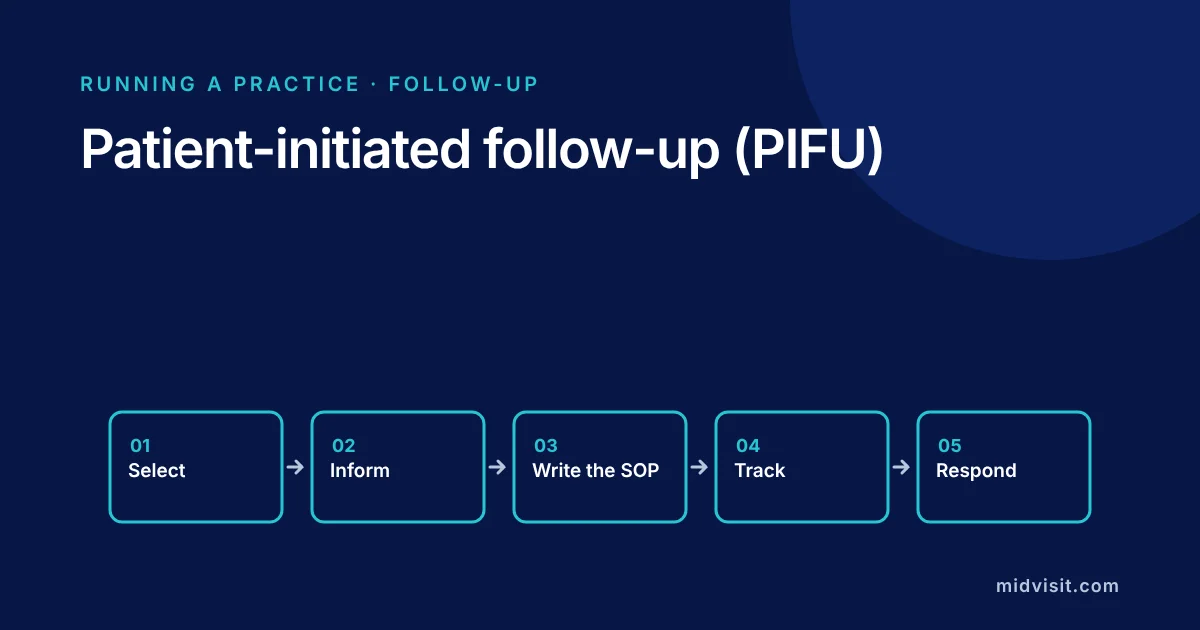
What is patient initiated follow-up? It is an arrangement where a suitable patient, or their carer, books a follow-up appointment when symptoms or circumstances change, instead of attending routine fixed reviews. NHS England guidance limits it to low-risk patients, backed by clear information, a safety-netting procedure and tracking of every patient on the pathway.
Patient-initiated follow-up (PIFU) replaces some routine review appointments with open access. The patient gets in touch when they need the team, rather than coming back on a fixed date that may not suit their recovery or condition.
This guide explains how NHS England runs PIFU, what the evidence shows and what a private clinic can adapt. It sits alongside our overview of how follow-up works with Midvisit, and it is written for owners, clinical leads and practice managers.
What is patient-initiated follow-up (PIFU)?
PIFU describes when a patient, or their carer, can start a follow-up appointment when they need one. It replaces some routine appointments booked at fixed intervals, according to NHS England guidance on implementing PIFU.
You may also see it called open access follow-up, patient-led follow-up or "see on symptom". The idea is the same. The clinic stays available for a set period, and the patient decides when to use that access.
PIFU sits within wider NHS outpatient reform. NHS England describes it as a key intervention in its Elective Reform Plan, helping providers see the patients most in need more quickly.
How does PIFU work in the NHS?
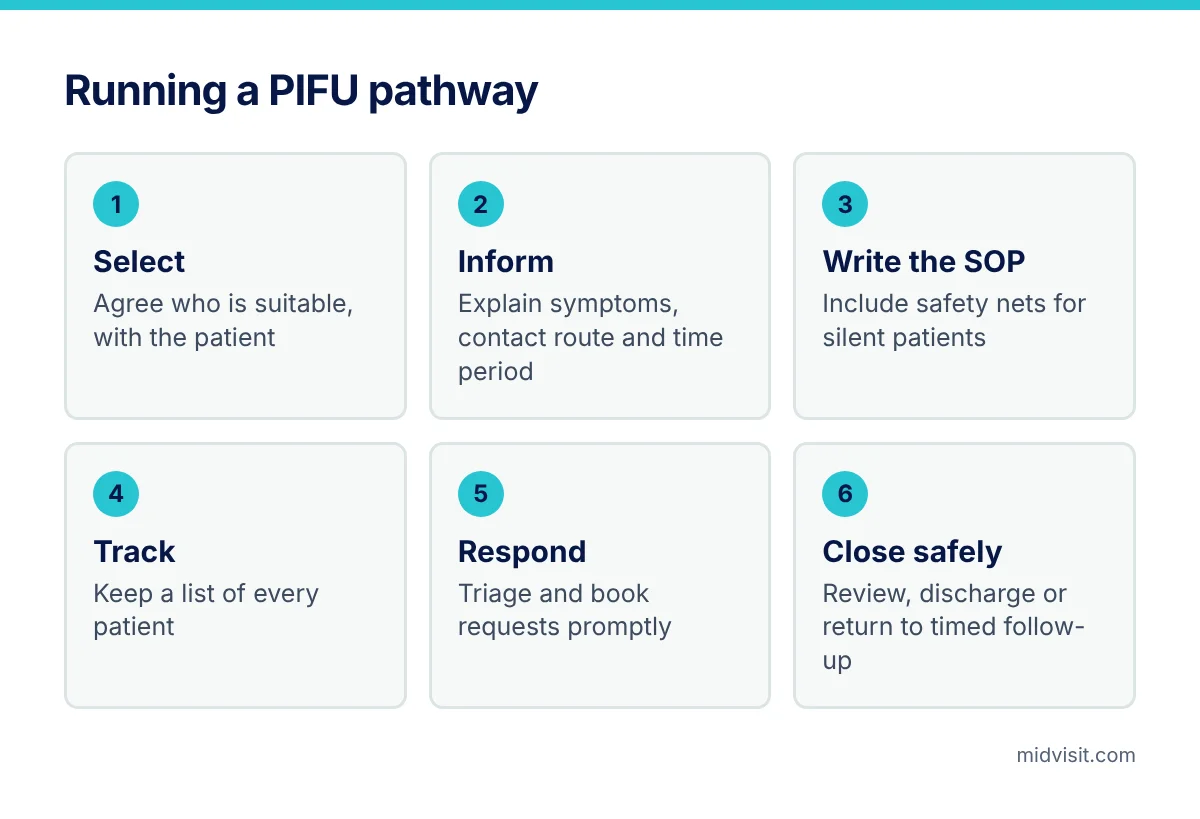
A clinician and patient agree that the patient will move onto PIFU, usually at the end of an outpatient appointment. The patient is told which symptoms or changes should prompt contact, how to get in touch and how long the arrangement lasts.
NHS England guidance sets three minimum quality standards for PIFU:
- Information. Every patient and carer receives detailed information on how and when to request an appointment.
- A standard operating procedure. The service has a written procedure that includes patient safety nets.
- Tracking. Every patient moved onto PIFU is tracked in the organisation's IT system, with the ability to report on key metrics.
The guidance also says PIFU should not be used as a substitute for discharging patients at the end of their care. It asked systems to offer PIFU as standard in all appropriate pathways by March 2026.
Who is PIFU suitable for?
PIFU suits patients at low risk of needing urgent follow-up who can confidently manage their own care. NHS England guidance says they should understand the status of their condition and know how to book directly with the service.
The decision should be shared with the patient where possible. NHS England also says PIFU must not be used to move people off a waiting list without a shared decision-making conversation.
Specialty guides show where the line falls. The trauma and orthopaedics PIFU guide lists pathways from minor hand surgery to hip and knee replacement, each with its own period. The adult rheumatology guide lists patients less likely to benefit, so suitability is a clinical call, not an administrative one.
How long does a PIFU period last?
There is no single national length. The clinician sets it for each pathway or patient, and NHS trusts publish a wide range.
- University Hospitals Sussex describes open access for between 6 and 12 months from the outpatient appointment.
- Newcastle Hospitals says the timeframe can range from three months to five years.
- The trauma and orthopaedics guide gives 3 months for some minor hand procedures and 5 years for elective hip and knee replacement.
What happens at the end matters as much as the length. The rheumatology guide describes a review at the end of the PIFU period that acts as a safety-net appointment. The orthopaedics guide asks teams to agree how to end each pathway safely, so patients do not get lost in the system.
What does the evidence say about PIFU?
The evidence suggests PIFU is acceptable for well-selected patients, but most studies are small. Two systematic reviews are useful.
- A review of PIFU after cancer included 10 randomised trials, six in breast cancer. In breast cancer, the type of follow-up did not appear to affect recurrence detection or patient-reported outcomes, and PIFU may reduce clinic visits. All included studies had risk of bias concerns.
- A review of patient-initiated clinics for chronic or recurrent conditions, including rheumatoid arthritis and inflammatory bowel disease, found no evidence of harm. Patient and clinician satisfaction favoured the patient-initiated model.
In our view, the fair reading is this. PIFU can free capacity and suit confident patients. It has not been shown to improve clinical outcomes, so its safety rests on selection, information and safety nets.
Where can PIFU go wrong?
The main risk is silence. A patient who does not get in touch may be well, or may be struggling without realising the clinic wants to hear from them. This is the same gap that planned post-procedure check-in calls are designed to close.
NHS England guidance expects local procedures to cover patients who do not respond or engage, defaulting them back to a regular pathway. It also says patients should be able to return to timed follow-up if PIFU is not working for them.
Other common gaps are easy to spot in advance:
- Patients forget which symptoms should prompt contact.
- The contact route is unclear, or calls go to a general reception line.
- No one owns the list of patients on PIFU or checks it.
- The end of the period passes without a decision, so the patient is neither reviewed nor discharged.
What can private clinics adapt from PIFU?
Private clinics are not bound by NHS PIFU targets, but the model answers a familiar question. Which follow-up appointments add value, and which exist only because they were booked by default?
We recommend borrowing the three NHS minimum standards as an operating checklist. They are clear information, a written procedure with safety nets, and a tracked list of every patient on open access. None of these needs an NHS system.
Private clinics can also combine both approaches. A patient can have open access between appointments and still receive a small number of clinic-initiated check-ins at points your clinical team chooses. The check-in becomes a safety net against silence, rather than a routine review. For what a structured call can cover after a procedure, see our guide to post-operative check-in calls.
If you are weighing staff time against automated calls, our cost comparison of manual and automated follow-up sets out the inputs. For patients who need closer, hospital-level oversight at home, PIFU is the wrong model; our explainer on virtual wards covers that end of the spectrum.
Questions to agree with your clinical team before offering PIFU
There is no single PIFU protocol for private practice. Take these questions to your clinicians and agree answers for each pathway before you offer open access.
Record the answers in your standard operating procedure. Review them once the team has run the pathway with real patients.
How Midvisit helps
Midvisit is an AI patient follow-up platform for private clinics. Its voice agent, Mira, calls patients between appointments and flags concerns for clinician review after each call. PIFU depends on the patient getting in touch. Midvisit works the other way round: the clinic contacts the patient. The two can sit side by side. With Midvisit, the clinic enrols each patient in an agreed follow-up pathway and decides suitability, consent, call timing and who reviews the results. Mira can make scheduled calls at points your team chooses, and staff can start a call manually. Each call produces an outcome, duration, transcript and AI-generated summary, and unanswered calls stay in the call history. Responses that meet your configured alert criteria are routed to assigned clinicians after the call. Mira does not make clinical decisions or respond to emergencies, as set out in our clinical oversight approach.
FAQs
What does PIFU stand for?
PIFU stands for patient-initiated follow-up. Instead of returning on a fixed date, a suitable patient or carer contacts the service to book a follow-up appointment when they need one. NHS England promotes it as part of outpatient reform. It is sometimes called open access follow-up or patient-led follow-up.
Is patient-initiated follow-up safe?
Systematic reviews in cancer and long-term conditions found no clear evidence of harm in well-selected patients, and some found fewer clinic visits. The studies were small and carried risk of bias. NHS England guidance relies on safeguards: careful patient selection, clear written information, a procedure with safety nets and tracking of every patient on the pathway.
How long does PIFU last?
There is no national standard. NHS trusts publish periods from three months to five years, depending on specialty and condition. NHS England's orthopaedics guide gives three months for some minor hand procedures and five years after hip and knee replacement. Your clinical team should set the period for each pathway and decide what happens at the end.
What happens at the end of a PIFU period?
This depends on the local procedure. Some services offer a final safety-net review, some discharge the patient with written advice, and some return the patient to timed follow-up. NHS England guidance says PIFU should not replace discharge at the end of care, so the end point should be planned rather than left to lapse.
Who should not be offered PIFU?
PIFU is meant for patients at low risk of needing urgent follow-up who can confidently manage their care and know how to book. Patients with outstanding tests, decisions still to be made, or limited confidence or access may be better on timed follow-up. Specialty guides list examples, but suitability remains a clinical judgement for each patient.
Can private clinics use patient-initiated follow-up?
Yes. PIFU is an NHS term, but the model works in private practice if the clinic sets it up carefully. Borrow the NHS minimum standards: clear patient information, a written procedure with safety nets, and a tracked list of patients. Your clinical team should decide suitability, the length of open access and any planned contact.
How is PIFU different from scheduled check-in calls?
In PIFU, the patient starts contact. In a scheduled check-in, the clinic does, at points agreed in advance. They can work together. Open access covers the times the patient notices a problem, while a small number of planned calls can catch patients who have gone quiet. Your clinical team should decide whether planned contact is needed.