
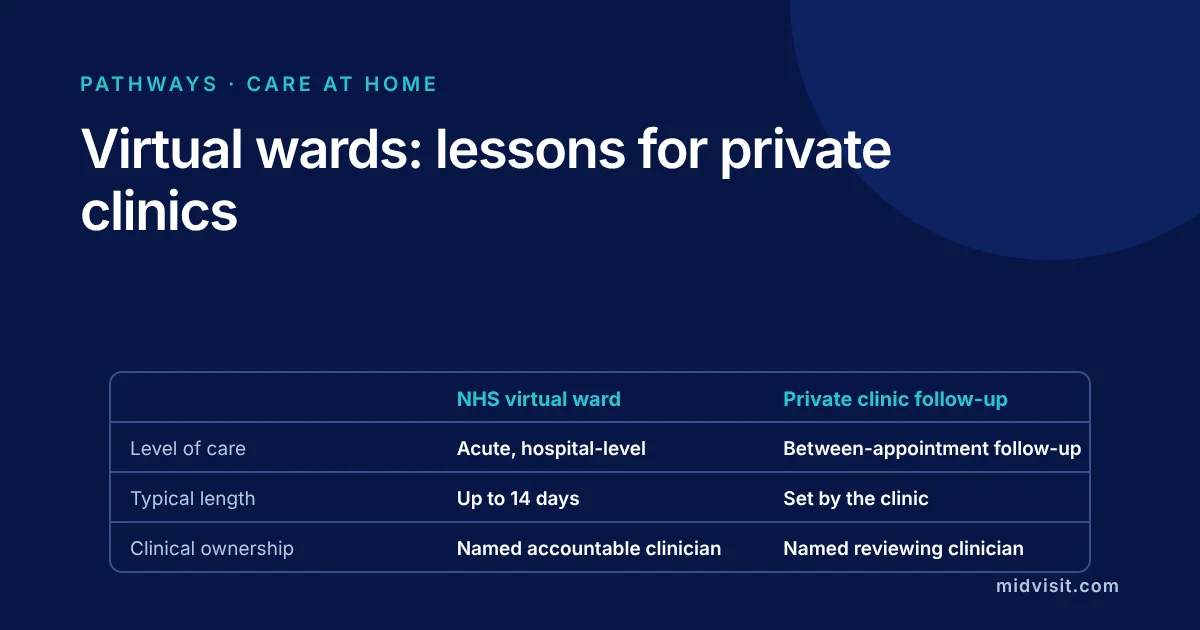
What are virtual wards? In the NHS, virtual wards, also called hospital at home, give selected patients acute, hospital-level care in their own home for a short stay, usually up to 14 days. A named clinician is accountable, the team reviews patients daily, and remote monitoring often supports that review.
Virtual wards are one of the NHS's biggest bets on care at home. They are also widely misunderstood. A virtual ward is not a phone line or an app: it is acute care, with a named clinician, delivered to a patient who would otherwise be in a hospital bed.
Private clinics rarely run anything like this. Still, the NHS model has worked through problems every clinic faces when it supports patients at home. This guide explains how virtual wards work, what the evidence shows and which lessons transfer to care programmes in private clinics.
What is a virtual ward?
NHS England describes a virtual ward as an acute clinical service delivered to selected people in their usual place of residence, including care homes. Staff, equipment, technology, medicines and skills usually provided in hospital are brought to the patient. It is a substitute for acute inpatient care, not an add-on to routine follow-up.
Patients can receive blood tests, prescribed medicines and intravenous fluids from a multidisciplinary team. They are reviewed daily, and the ward round may be a home visit or a video call. Many services use apps, wearables or other devices to monitor recovery.
Some services call themselves hospital at home. The NHS uses the two terms for the same model of care.
What is the difference between step-up and step-down virtual wards?
Virtual wards take patients from two directions. The difference is where the patient comes from.
- Step-up (admission avoidance). A patient who becomes acutely unwell is offered treatment at home instead of in hospital. Referrals can come from a single point of access, same day emergency care or the emergency department.
- Step-down (early discharge). A patient leaves an inpatient ward earlier than they otherwise would. They continue to receive treatment, oversight and diagnostics at home until they are ready for discharge.
NHS England's framework is also clear about what a virtual ward is not. It is not meant for routine GP-led care, or for intermediate care and reablement.
How does NHS England run virtual wards?
The virtual wards operational framework, published in August 2024, sets the core requirements. Several of them are about people and accountability rather than technology.
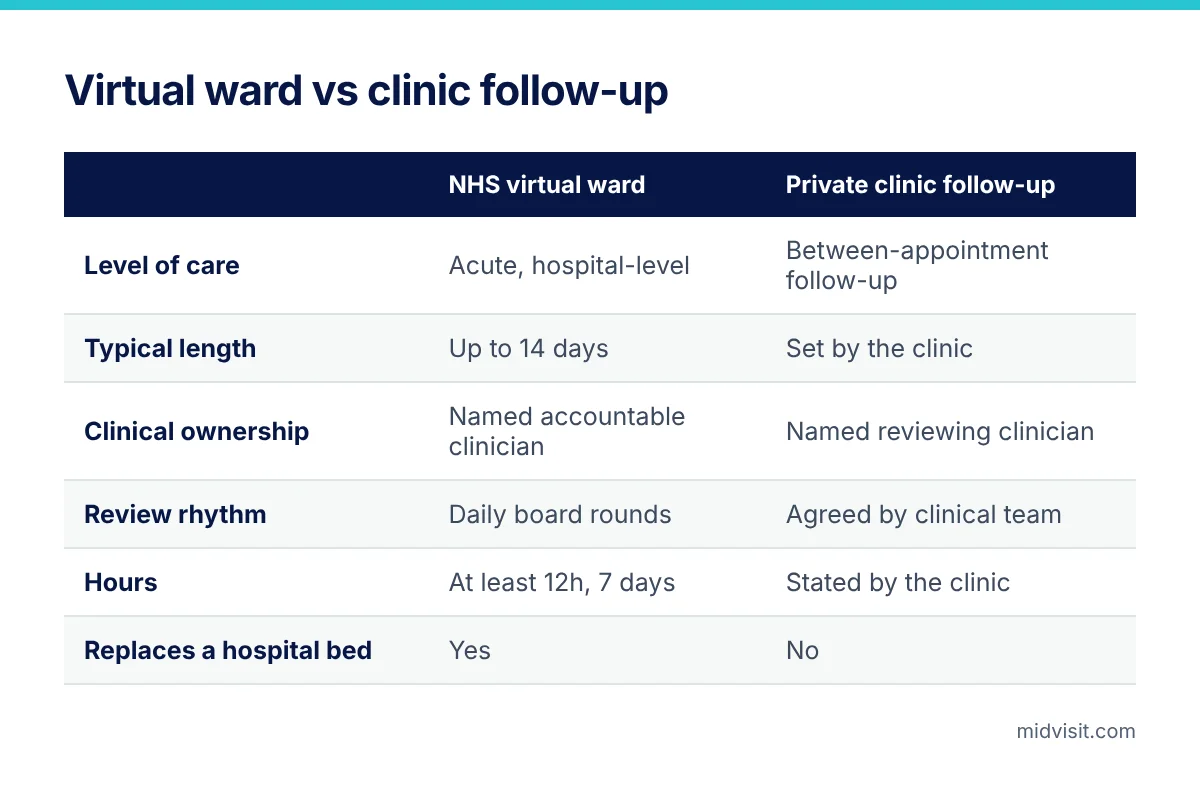
- Named accountable clinician. A consultant physician, consultant practitioner or GP oversees the service, and a named clinician is responsible for every patient.
- Daily board rounds. These are overseen by a senior clinical decision-maker, include medical input and are supported by a multidisciplinary team.
- Stated hours. Staffing for at least 12 hours a day (8am to 8pm), 7 days a week, with out-of-hours cover arranged locally.
- Early senior review. A consultant-level review within 24 hours of admission.
- Short stays. Length of stay is expected to be short, up to 14 days.
The companion guide to technology-enabled virtual wards covers platform requirements, standard operating procedures, training, data sharing agreements and clinical safety. It expects digital platforms to meet NHS England's Digital Technology Assessment Criteria (DTAC).
How big are NHS virtual wards?
The NHS scaled virtual wards quickly. The 2022/23 planning guidance set a national ambition of 40 to 50 virtual beds per 100,000 population by December 2023.
Later guidance shifted the focus from capacity to use. The 2024 framework asks systems to keep virtual ward utilisation consistently above 80%, with a focus on frailty, acute respiratory infection, heart failure and children and young people.
For a private clinic, the lesson is not the scale. It is that the NHS moved from counting beds to asking whether the service was used well, which is a sensible test for any home-based programme.
Do virtual wards work? What the evidence says
The evidence is mixed and still developing. Much of it comes from services set up at speed, so results vary by model, patient group and maturity.
- Hospital at home in trials. A 2024 Cochrane review of admission avoidance hospital at home found it probably makes little or no difference to mortality compared with in-hospital care.
- A regional evaluation. An independent evaluation for NHS England's South East region linked virtual wards to fewer non-elective admissions. On average, about 2.5 virtual ward admissions corresponded to one avoided hospital admission. Staff also reported operational pressures (NHS England summary).
- COVID-era remote monitoring. A national rapid evaluation of COVID virtual wards found no evidence that they shortened hospital stays or changed readmission rates. Many services launched as the second wave eased, which may have affected results.
- Frailty. An NIHR-funded rapid realist review found frailty virtual wards work best with proactive care, a whole-system approach and a team-of-teams model. It found evidence on remote monitoring was thin.
In our view, the honest summary is that virtual wards can be as safe as hospital for selected patients. Benefits depend on how well the service is designed and run, not on the technology alone.
What can private clinics learn from virtual wards?
Most private clinics support patients at home after a procedure or between appointments. That is follow-up, not acute care, and it should not be described as a virtual ward. But the NHS model offers lessons that transfer well.
| NHS virtual ward principle | What it means for a private clinic |
|---|---|
| Clear eligibility | Decide which patients and procedures the programme is for, and who it is not for |
| Named accountable clinician | Every enrolled patient has a named reviewer, with cover for leave |
| Stated hours | Tell patients when the team is available and what to do outside those hours |
| Short, defined stay | Set a start and end date for each programme, and plan what happens at the end |
| Written procedures and clinical safety | Document the pathway, alert criteria and review process before go-live |
| Measure use, not just capacity | Track who was enrolled, who was reached and what the team acted on |
One lesson matters most. The framework puts a named clinician at the centre of every patient's care. Software can collect and route information, but someone must own each decision.
For a worked example of these principles after surgery, see our guide to post-operative remote monitoring in the first 14 days, and how post-procedure check-in structures that contact. Not every patient needs planned contact at all. Our guide to patient-initiated follow-up covers when open access is the better fit.
Questions to agree with your clinical team before supporting patients at home
No national standard tells a private clinic how to run home follow-up. Use these questions, drawn from the virtual ward framework, to agree your own answers for each programme.
A virtual ward exists to replace a hospital bed. A private clinic programme usually exists to make sure nothing is missed between appointments. Keeping that difference clear protects patients and keeps promises realistic.
We recommend testing any new home programme with one pathway and a fixed review date before expanding. Our guide to running a 90-day remote monitoring pilot sets out how, and our decision guide for small practices helps you judge whether it is worth doing at all.
How Midvisit helps
Midvisit is an AI patient follow-up platform for private clinics. Its voice agent, Mira, calls patients between appointments and flags concerns for clinician review after each call. Midvisit is not a virtual ward and does not provide acute or emergency monitoring. It supports structured follow-up between appointments. The clinic enrols each patient in an agreed pathway and decides suitability, consent, call timing and who reviews the results. Mira asks the structured questions set by that pathway, and staff can also start calls manually. Each call produces an outcome, duration, transcript and AI-generated summary, and unanswered calls stay in the call history. Responses that meet the clinic's configured alert criteria are routed to assigned clinicians after the call, and the reviewing clinician can call the patient back and record a note. Clinical decisions stay with your team, as set out in our clinical oversight approach.
FAQs
What is a virtual ward?
A virtual ward is an NHS service that gives selected patients acute, hospital-level care at home instead of in a hospital bed. A multidisciplinary team provides tests, medicines and treatment, reviews patients daily and often uses remote monitoring. NHS England describes it as a substitute for inpatient care. Some services call it hospital at home.
How long do patients stay on a virtual ward?
NHS England's operational framework expects stays to be short, up to 14 days. The patient is then discharged or moved to another service. A private clinic follow-up programme is different: its length is set by the clinic's own clinical team, based on the procedure or condition and the patient's needs.
Are virtual wards safe?
A 2024 Cochrane review found admission avoidance hospital at home probably makes little or no difference to mortality compared with hospital care, for selected patients. Safety depends on patient selection, named clinical ownership, daily senior review and clear out-of-hours arrangements, which is why NHS England's framework sets these as core requirements.
What is the difference between a virtual ward and remote monitoring?
Remote monitoring is a tool: collecting information such as symptoms or readings from patients at home. A virtual ward is a full acute service that may use remote monitoring, alongside clinical staff, tests, medicines and daily reviews. Monitoring alone does not make a service a virtual ward.
Do virtual wards reduce hospital admissions?
Results vary. An evaluation for NHS England's South East region linked virtual wards to fewer non-elective admissions, with about 2.5 virtual ward admissions per avoided hospital admission. A national evaluation of COVID-era virtual wards found no evidence they shortened stays or changed readmissions. Outcomes depend on the model and how mature the service is.
Can a private clinic run a virtual ward?
Most private clinics do not provide the acute, hospital-level care a virtual ward involves. They support patients at home between appointments, which is follow-up rather than a virtual ward. Clinics can still borrow the governance lessons: clear eligibility, a named clinician for each patient, stated hours and a planned end point.