
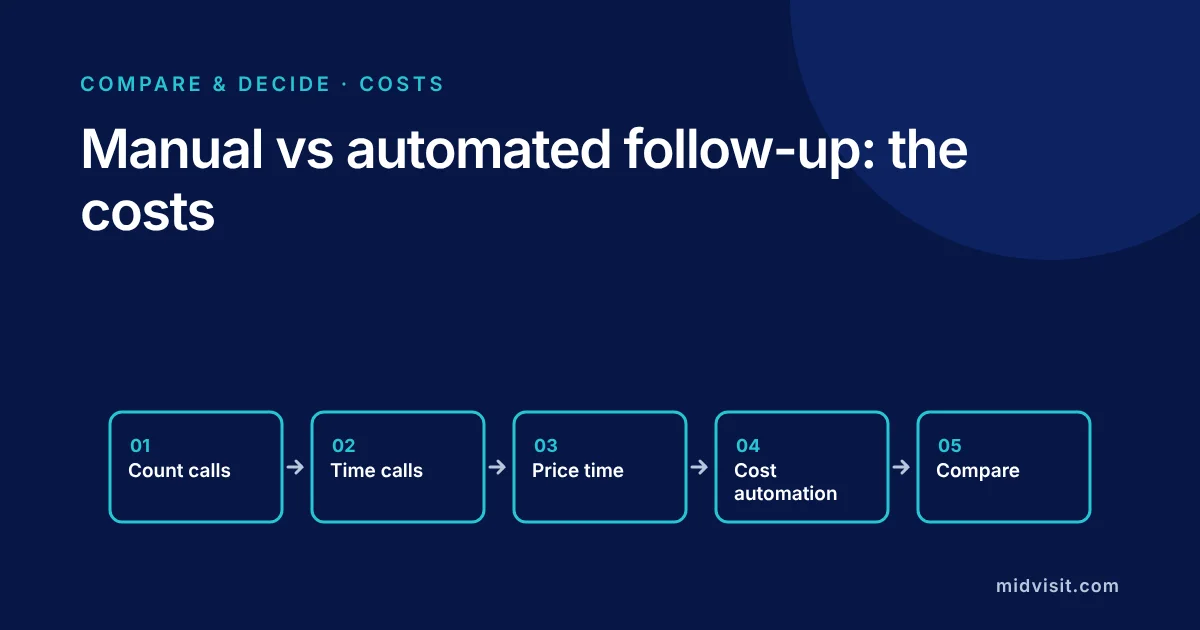
Is automated patient follow up cheaper than manual calls? It depends on your volume and on the staff time each call really takes. Manual cost is staff minutes multiplied by an hourly rate. Automation swaps some of those minutes for a software fee, but clinician review time remains. The formula below lets you test your own figures.
Most clinics know what follow-up software would cost, because there is a quote. Few know what their current manual follow-up costs, because it is spread across nurses' and receptionists' days. That makes the comparison lopsided.
This guide sets out an illustrative cost model with every assumption stated. You fill in your own figures. We use published NHS pay rates only as a benchmark, and we do not claim any saving. If you want to test the model against a real workflow, you can book a demo and bring your own numbers.
What is automated patient follow-up?
Automated patient follow-up is planned contact with patients between appointments that software starts and runs, rather than a member of staff. It can be a text, an online form or a phone call made by an AI voice agent.
Manual follow-up is the same contact made by a person, usually a nurse, healthcare assistant or receptionist working through a list. Both aim to find out how the patient is doing and pass anything concerning to a clinician.
This guide focuses on structured check-ins, where the patient answers set questions. Simple reminders are a different job, and texts usually do them more cheaply. We compare those channels in AI voice calls vs SMS reminders.
What does manual follow-up actually cost a clinic?
The main cost of manual follow-up is staff time. It is easy to undercount, because a completed call is only part of the work.
When you count the time, include each of these:
- Preparation. Finding the patient, the procedure and the questions to ask.
- Unanswered attempts. Dialling, waiting, leaving a message and noting the attempt.
- The completed call. Identity check, questions and the patient's own questions.
- Notes. Writing up the call in the patient record.
- Hand-offs. Passing concerns to a clinician, who then reviews and may call back.
- Interruptions. Calls squeezed between other tasks often take longer than planned.
There are also costs that are harder to price. Calls slip on busy days. Different staff ask different questions. Notes vary in detail. These do not appear on a payslip, but they affect how reliable your follow-up is.
What does an hour of staff time cost?
Use what you actually pay. If you need a benchmark, NHS Agenda for Change (AfC) rates are published and widely used in UK healthcare. Private clinics set their own pay, so treat these as a reference only.
| Band | Typical follow-up role | Hourly rate | Annual |
|---|---|---|---|
| Band 3 | Administrative or clinical support | £13.17 | £25,760 |
| Band 4 | Senior support or assistant practitioner | £14.52 | £28,392 |
| Band 5 | Registered nurse, newly qualified | £16.40 | £32,073 |
| Band 6 | Experienced or specialist nurse | £20.44 | £39,959 |
Source: NHS Employers pay scales for 2026/27, also in the NHS Employers 2026 AfC pay scales document. Full-time AfC staff work 37.5 hours a week, excluding meal breaks, under the NHS Terms and Conditions of Service Handbook. The role examples are typical, not fixed.
These are basic pay only. They exclude higher cost area supplements, employer National Insurance, pension contributions and leave cover. Add your own on-cost percentage to reach a true hourly cost.
An illustrative cost model you can fill in
Illustrative example. This model shows the arithmetic, not a result. Every input is a variable for you to replace with your own figures.
Step 1: manual monthly cost
- N = patients followed up per month.
- C = check-in calls per patient.
- T = staff minutes per completed call, including preparation and notes.
- U = unanswered attempts per completed call, and t = minutes per attempt.
- H = hourly rate, and O = employer on-costs as a percentage.
Manual hours per month = N × C × (T + U × t) ÷ 60.
Manual cost per month = manual hours × H × (1 + O ÷ 100).
Step 2: how sensitive is the cost to call length?
The table shows basic pay cost for 100 completed calls at three call lengths. It uses the AfC entry rates above and nothing else. It leaves out unanswered attempts, on-costs and clinician review, so real costs will be higher.
| Minutes per call | Staff hours | Band 3 | Band 5 | Band 6 |
|---|---|---|---|---|
| 5 minutes | 8.3 | £110 | £137 | £170 |
| 10 minutes | 16.7 | £220 | £273 | £341 |
| 15 minutes | 25.0 | £329 | £410 | £511 |
Two things stand out. Call length matters as much as pay band. And small amounts of time per call add up quickly at volume. Time your own calls before you rely on any figure here.
What does automated follow-up cost?
Automated follow-up replaces some staff minutes with a software cost. It does not replace all of them. Count these inputs for the automated side:
- S = software cost per month, from the vendor's quote.
- R = clinician hours per month reviewing flagged responses and calling patients back.
- E = staff hours per month on exceptions, such as patients who never answer or ask for a person.
- G = one-off set-up and governance time, spread over the months you expect to use it.
Automated cost per month = S + (R + E) × your hourly cost + G.
Governance time is real. The ICO says you must carry out a data protection impact assessment for processing likely to result in a high risk to individuals. NHS England Digital's clinical risk management standards, DCB0129 and DCB0160, cover the clinical safety of health IT for manufacturers and deploying organisations. Check with your adviser whether they apply to your clinic, and allow time for the work either way.
The break-even test
Automation pays for itself, on time alone, when the staff cost it saves is greater than the software cost. Put simply: (manual hours − R − E) × hourly cost > S + G. If that is not true at your volume, the case has to rest on other benefits, or it is not yet worth it.
What does a cost model miss?
A spreadsheet captures time and money. It misses some things that matter to clinics, in both directions.
Points that can favour automation:
- Every patient on the pathway gets the same agreed questions.
- Calls go out on schedule even on busy clinic days.
- Records, such as transcripts and summaries, are produced the same way each time.
- Nurses spend their call time on the patients who need a clinician.
Points that can favour manual calls:
- A nurse can follow up a vague answer, notice tone and reassure.
- Some patients prefer a person, and some will not engage with software.
- Calls build a relationship with the clinic that a script may not.
Be cautious about outcome claims either way. A Cochrane review of telephone follow-up after hospital discharge found inconclusive evidence of benefit, even with health professionals making the calls. A separate Cochrane review of text message reminders found texts performed about the same as phone calls for attendance. The channel and its cost matter, but neither guarantees better outcomes.
When is manual follow-up the better choice?
Manual follow-up is often the better choice when volume is low or every conversation is different. In our view, automation is hard to justify on cost in these cases:
- Low volume. A few calls a week rarely costs more than a software subscription.
- Complex conversations. If most calls need clinical judgement from the first question, a script adds little.
- Sensitive pathways. Some patients and conditions need a person on the line. Your clinical team should decide which.
- No review capacity. Automation creates flags. If nobody has time to review them, it creates risk, not savings.
Many clinics end up with a mix. Routine check-ins are automated and a person calls the patients who need one. Our guide to whether remote monitoring is worth it for a small practice goes through this decision in more detail.
Questions to agree with your clinical team before you automate
Some inputs to the model are clinical decisions, not finance ones. Agree these with your clinical team before you run the numbers.
The answers set C, R and E in the model. They also decide whether automation is safe for a pathway at all, which comes before any cost question.
How to run the comparison in your clinic
We recommend measuring before you buy. Estimates of call time are usually optimistic.
- Pick one pathway. Choose one with a steady number of patients and a set of routine questions.
- Time two weeks of calls. Record minutes per completed call, unanswered attempts and notes time.
- Price the time. Use your real pay rates plus on-costs.
- Get a quote. Ask vendors for the full monthly cost at your volume and what set-up involves.
- Estimate review time. Ask your clinical team how long reviewing flags is likely to take.
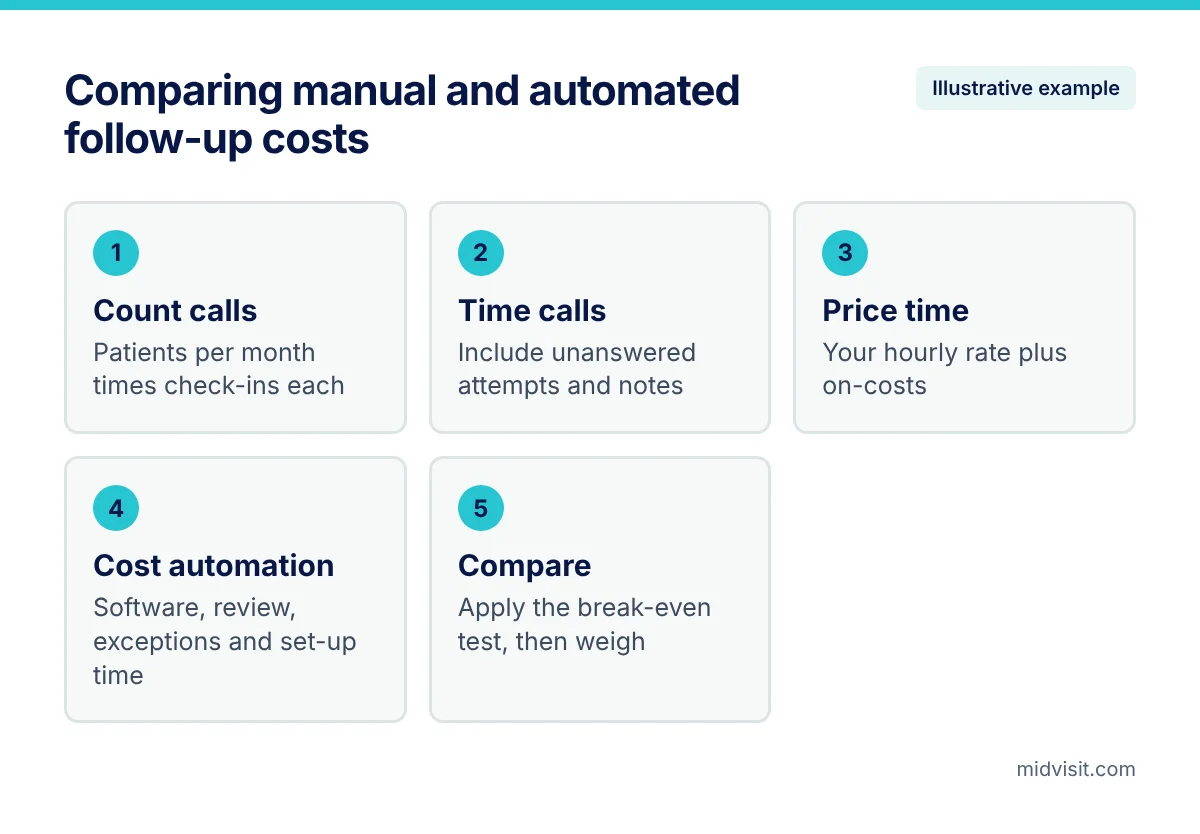
- Compare and decide. Use the break-even test, then weigh the points the model misses.
If the numbers look close, a time-limited pilot on one pathway gives you real data. Our guide to running a 90-day remote monitoring pilot covers how to set one up.
How Midvisit helps
Midvisit is an AI patient follow-up platform for private clinics. Its voice agent, Mira, calls patients between appointments and flags concerns for clinician review after each call. For clinics where staff already phone patients with the same questions, Mira can make those structured check-in calls instead. Calls can be scheduled, started manually by staff or triggered by configured alerts. Each call produces an outcome, duration, transcript and AI-generated summary, and unanswered or interrupted calls stay in the call history. After the call, responses that meet the clinic's alert criteria are routed to assigned clinicians, who can call the patient from the alert and record a note. That review time stays in your cost model. See how Midvisit works or the live post-procedure check-in pathway. Pricing is agreed separately for each clinic.
FAQs
Is automated patient follow-up always cheaper than manual calls?
No. It depends on how many patients you follow up, how long each call takes and what the software costs. At low volumes, a few manual calls a week may cost less than any subscription. Automation is more likely to pay off where many patients get the same routine questions. Run the break-even test with your own figures.
What hourly rate should I use for staff time?
Use what you actually pay, plus employer on-costs such as National Insurance and pension contributions. If you need a benchmark, NHS Employers publishes Agenda for Change rates. From April 2026 the entry rates are £13.17 an hour at band 3, £16.40 at band 5 and £20.44 at band 6, before on-costs.
Does automated follow-up remove the need for clinician time?
No. Software can ask set questions and record the answers, but a clinician still needs to review responses that meet the alert criteria and decide what to do. That review time, and time spent on patients who cannot be reached, belongs in the automated side of your cost comparison.
What costs are easy to forget in a follow-up cost comparison?
On the manual side, people forget unanswered attempts, writing notes and passing concerns to a clinician. On the automated side, they forget clinician review time, handling exceptions and set-up work, including governance such as a data protection impact assessment. Leaving these out makes either option look cheaper than it is.
How many patients do you need before automation pays off?
There is no fixed number. It depends on call length, pay rates, software cost and review time. Use the break-even test: automation pays for itself on time alone when the staff cost it saves exceeds the software and set-up cost. If it does not, the case must rest on consistency or records.
Do follow-up calls improve patient outcomes?
The evidence is limited. A Cochrane review of telephone follow-up after hospital discharge found inconclusive evidence of benefit, though no adverse effects were reported. That is why this guide compares cost, time and consistency, not outcomes. Judge any vendor's outcome claims against published evidence.
Does Midvisit publish its pricing?
No. Midvisit does not publish pricing on its website. Pricing, pilot terms and set-up are agreed separately with each clinic. You can book a demo, bring your own follow-up volumes and call times, and use them to test the cost model in this guide.