
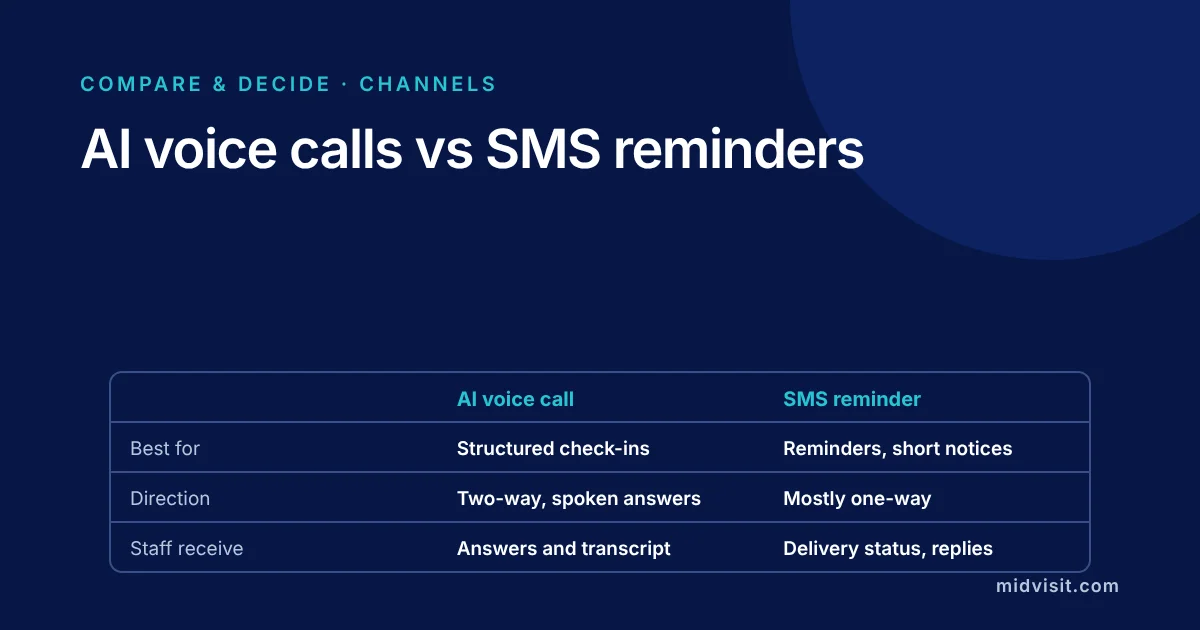
How do AI voice calls vs SMS reminders compare for patient follow-up? SMS is cheap and well suited to one-way messages, such as appointment times. AI voice calls suit structured two-way check-ins, where the patient answers set questions and the care team reviews the responses. Most clinics need both, each matched to a different job.
Text reminders are the default for most clinics. They are cheap, familiar and good at one thing: telling a patient something. Follow-up after a procedure or between prescriptions often needs the opposite. The clinic needs to hear from the patient, in a structured way, and route anything concerning to a clinician.
This guide compares the two channels fairly, including where SMS wins. It ends with a decision table and the questions to settle before you choose. If you would rather see a voice check-in working, you can book a demo of Midvisit's patient follow-up calls.
What is the difference between an AI voice call and an SMS reminder?
An SMS reminder is a short text sent to a patient's mobile. It is mainly one-way: the clinic tells the patient something, and replies, if allowed, are short and unstructured. An AI voice call is a phone call made by software that speaks, listens and records the patient's answers to set questions.
The two channels do different jobs. A reminder pushes information out. A check-in call brings information back, so the care team can see how the patient is doing between appointments.
What an SMS reminder usually does
- Confirms an appointment date, time and place.
- Sends a short instruction, such as a fasting reminder before a procedure.
- Asks for a simple reply, such as confirming or cancelling.
What an AI voice check-in call usually does
- Asks a fixed set of questions agreed by the clinic, for example about pain or medication.
- Records the answers, with a transcript and a summary for staff to read.
- Lets the clinic's alert rules pick out answers that need a clinician to review.
An AI voice call is also different from an older automated phone menu, where patients press keys. The patient answers in their own words. For a call-by-call view of how a structured check-in runs, see our post-operative follow-up call protocol.
What does the evidence say about text reminders and phone calls?
The evidence on text reminders is reasonably good for one outcome: turning up to appointments. The evidence on AI voice agents is thin, and we found no trial comparing them directly with SMS for follow-up.
A Cochrane review of mobile phone messaging reminders (2013) found:
- Text reminders improved attendance compared with no reminder (7 studies, 5,841 participants, risk ratio 1.14).
- Text reminders performed about the same as phone call reminders (3 studies, 2,509 participants, risk ratio 0.99).
- The authors rated the evidence low to moderate quality.
That matters here. These trials measured whether people attended, not whether problems at home were spotted.
One randomised trial in an academic primary care clinic found text reminders were equivalent to telephone reminders for missed appointments and more cost-effective. Note that the phone reminders in these studies were mostly made by people or simple recorded messages, not conversational AI.
For two-way automated calls, the closest evidence is on interactive voice response. A 2018 meta-analysis of interactive voice response interventions found them promising for specific behaviours such as taking medication. Effects were modest and varied by design.
In our view, the honest reading is this. For reminders, SMS is proven and cheaper. For structured check-ins, the case for voice rests on what the call can collect, not on trial results.
AI voice calls vs SMS: a side-by-side comparison
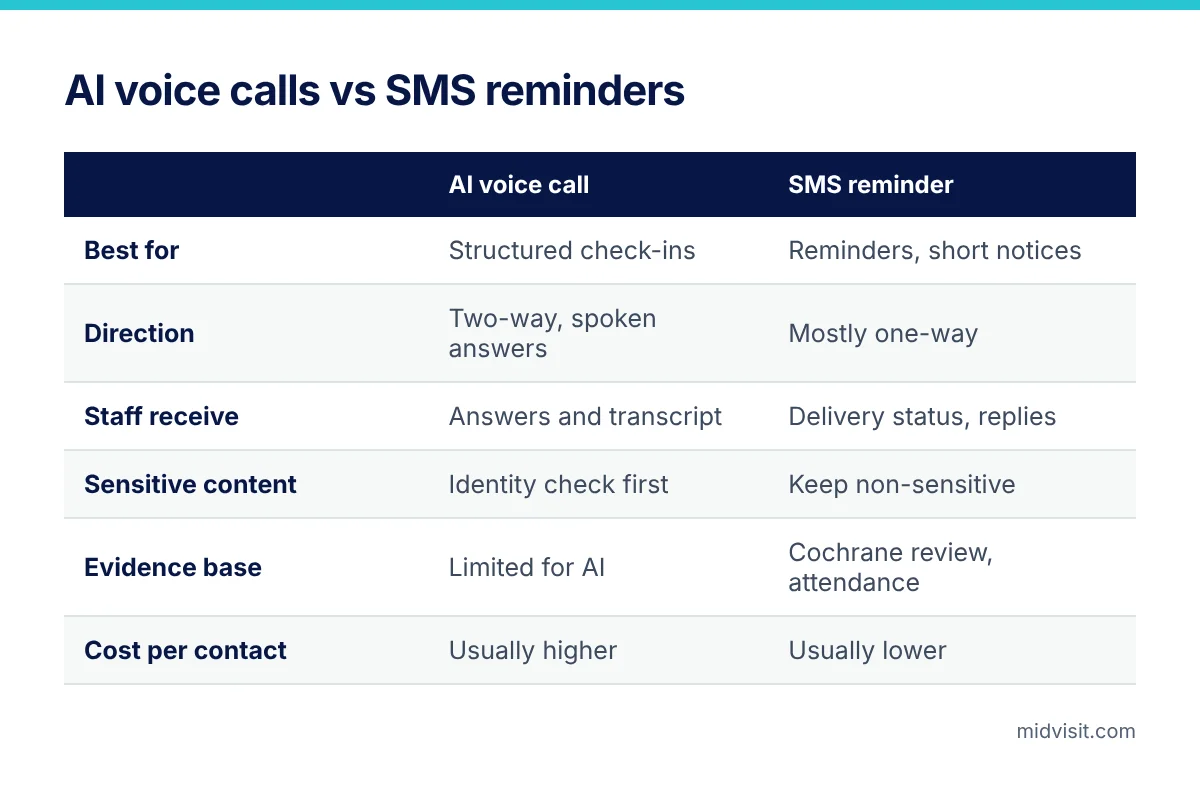
Neither channel is better across the board. The table compares them on the points that matter for follow-up between appointments.
| Factor | AI voice call | SMS reminder |
|---|---|---|
| Best for | Structured check-ins with several questions | Reminders and short notices |
| Direction | Two-way: the patient answers in their own words | Mostly one-way; replies are short |
| What staff receive | Answers, transcript and summary, depending on the product | Delivery status and any reply text |
| Patient effort | Answer the phone at that moment | Read when convenient |
| Sensitive content | Needs an agreed identity check before health questions | NHS guidance says keep it non-sensitive |
| Accessibility | Suits people who find reading hard; less suited to people with hearing loss | Suits people with hearing loss; less suited to people who find reading hard |
| Evidence base | Limited for AI voice agents | Cochrane review for attendance |
| Cost per contact | Usually higher; get quotes | Usually lower; studies found text cheaper than phone reminders |
The accessibility row deserves attention. NHS England's Accessible Information Standard asks services to identify, record, flag, share and meet people's communication needs. Whichever channel you choose, you need a route for patients who cannot use it.
When is an SMS reminder the right choice?
Use SMS when the message is short, one-way and not sensitive. In those cases a text is quicker for the patient and cheaper for the clinic than any call.
- Appointment reminders. This is where the evidence is strongest.
- Logistics. Parking, arrival times, what to bring.
- Simple confirmations. Confirm or cancel, where your system handles replies.
- Signposting. A reminder of who to contact, sent alongside written discharge advice.
SMS has limits for follow-up. The NHS template policy for email and text message communications says texts should carry only non-sensitive information. It also says patients should know messages are not read out of hours and should not be used for urgent queries. That rules out most symptom questions by text.
Replies are also hard to act on. A patient who texts back "wound a bit red" has given you a fragment. Someone still has to read it, decide what it means and phone the patient.
When does an AI voice call make more sense?
A voice call makes more sense when the clinic needs answers, not acknowledgement. That usually means several questions, a record of what was said and a clear route to a clinician.
- Post-procedure check-ins. Pain, the wound site, temperature and medication are hard to cover in a text. See how this works on our post-procedure check-in pathway.
- Medication questions. Missed doses and side effects are easier to describe out loud.
- Patients who find reading or typing hard. A call needs no app, link or reading.
- Replacing routine staff calls. Where nurses already phone every patient with the same questions, a structured call can take on the routine part. The cost side is covered in our manual vs automated follow-up cost comparison.
Voice has limits too. Patients may miss the call, and some will not want to talk to software. Older phone trials, such as the Cochrane review of telephone follow-up after hospital discharge, found inconclusive evidence of benefit even with health professionals making the calls. A call is only as useful as the questions and the review behind it.
What are the privacy and consent rules for texts and AI calls?
Both channels carry patient data, so both need a lawful basis, transparency and security. The main difference is that AI voice calls add an AI system to the processing, which the ICO treats as a higher-risk area.
- Reminders are not marketing. The ICO's guidance on marketing and data protection lists appointment reminders as service messages. Add a promotion and the message can become direct marketing.
- Individual care. The NHS template policy for email and text communications says implied consent is appropriate for contacting patients about their individual care, and recorded preferences must be respected.
- A DPIA first. The NHS template says a data protection impact assessment must be completed before a messaging service starts. The ICO says a DPIA is likely to be required when using AI systems to process personal data.
For AI calls, also agree how the call confirms it is speaking to the right person before any health questions. Tell patients in advance that the call comes from software working for their clinic.
Questions to agree with your clinical team before choosing a channel
The channel decision is partly clinical. What you ask, and what happens to the answer, should be settled by your clinicians, not by the software. Take these questions to your clinical team.
We also recommend asking any vendor, for either channel, four operational questions. Where is data stored? What does staff see after each contact? What happens when a patient does not answer or reply? Which parts are live today, and which are on a roadmap?
How to combine voice calls and SMS in one pathway
Most clinics will use both. In our view, the simplest pattern is to keep text for logistics and use calls for structured check-ins.
- Keep your existing reminders. Most booking systems already send appointment texts.
- Tell patients a call is coming. Explain at consent or discharge who will call, roughly when and why.
- Use calls where answers matter. Agree the check-in questions with your clinical team.
- Agree what happens after a missed call. Decide how many attempts, and when a person picks it up.
- Keep a route in for patients. Patients should be able to contact you between planned contacts. Our guide to patient-initiated follow-up covers this side.
To be clear about Midvisit: it does not send SMS. Its voice agent, Mira, makes structured check-in calls. If you want texts and calls together, you would keep text reminders from your current system and run Mira's calls alongside them.
How Midvisit helps
Midvisit is an AI patient follow-up platform for private clinics. Its voice agent, Mira, calls patients between appointments and flags concerns for clinician review after each call. Midvisit does not send SMS. Mira phones patients and asks structured check-in questions set by the clinic's configured pathway, in English. Calls can be scheduled, started manually by staff or triggered by configured alerts. Each call produces an outcome, duration, transcript and AI-generated summary, and unanswered or interrupted calls stay in the call history. After the call, responses that meet the clinic's alert criteria are routed to assigned clinicians, who can call the patient from the alert and record a note. Clinics can keep text reminders from their own booking system alongside Mira's calls. Clinical decisions stay with the care team, as set out in our clinical oversight approach.
FAQs
Does Midvisit send SMS reminders?
No. Midvisit does not send SMS. Its voice agent, Mira, phones patients and asks structured check-in questions set by the clinic's pathway. Many clinics already send appointment texts from their booking system, and they can keep doing so alongside Mira's calls. The two do different jobs: texts remind, calls collect the patient's answers for care-team review.
Are text reminders as effective as phone call reminders?
For appointment attendance, the evidence suggests so. A 2013 Cochrane review found text reminders performed about the same as phone call reminders across three studies with 2,509 participants, and better than no reminder. The evidence was rated low to moderate quality, and the studies measured attendance, not health outcomes or follow-up between appointments.
Can an AI voice call replace a nurse's follow-up call?
It can take on the routine, structured part of a call, such as asking the same set of questions to every patient. It does not replace clinical judgement. A clinician still needs to review answers that meet the clinic's alert criteria and decide what happens next. Your clinical team should decide which patients still need a person to call.
Can clinics send health information by text message?
NHS information governance guidance says texts should carry only non-sensitive information, because a message may be seen by someone else on the patient's phone. It also says patients should be told texts are not read out of hours and should not be used for urgent queries. Symptom questions are usually better handled another way.
Do appointment reminder texts need marketing consent?
Not usually. The ICO treats appointment reminders as service messages, not direct marketing, provided they contain nothing promotional. If a reminder also promotes a paid service or offer, it can become direct marketing and marketing rules apply. Data protection law still applies to the reminder itself, including transparency and respecting recorded contact preferences.
Do patients need a smartphone for an AI voice call?
No. An AI voice call is an ordinary phone call, so patients only need a phone that can receive calls. That can make calls easier for patients who struggle with apps, links or reading. Patients with hearing loss may need another route, and the Accessible Information Standard asks services to record and meet communication needs.
What happens if a patient misses an AI voice call?
That depends on the product and on what the clinic agrees. With Midvisit, unanswered or interrupted calls stay in the call history, so staff can see who has not been reached. Retry behaviour and who follows up a missed call are agreed for each pathway. Decide this before go-live, so no patient is left without contact.