
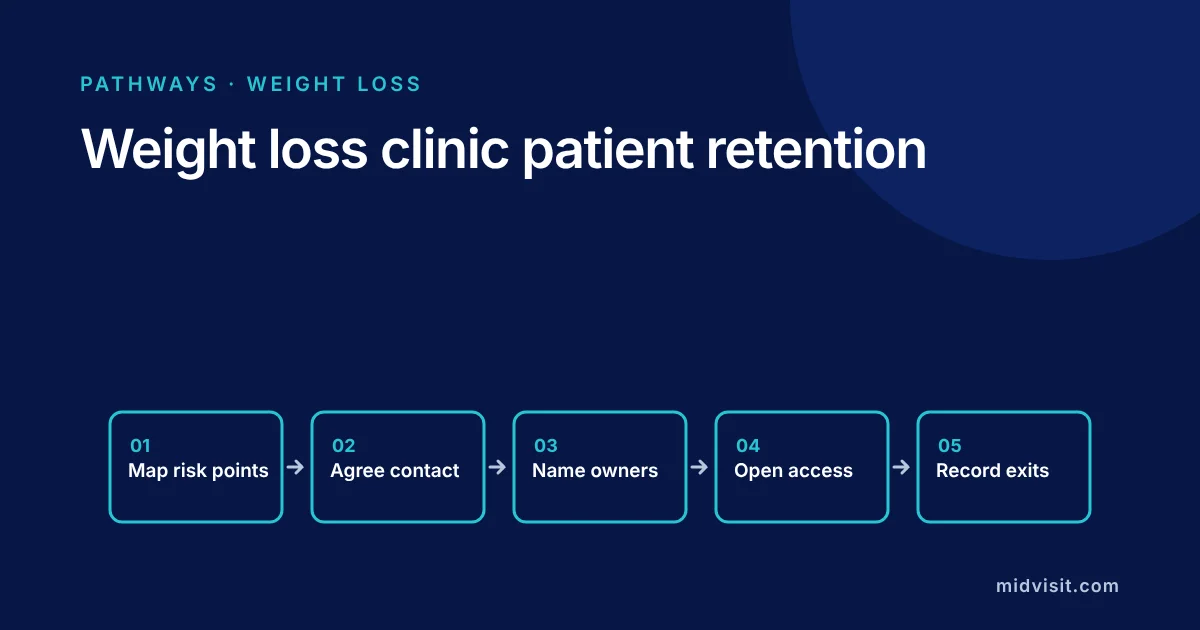
Weight loss clinic patient retention means keeping patients engaged in care for as long as treatment is right for them. Evidence shows many patients stop GLP-1 medicines within a year, often after side effects or slower progress. Planned contact at those moments, and easier access to the team between appointments, are the clearest levers.
For a weight loss clinic, a patient who quietly stops is a clinical problem before it is a commercial one. They may stop because of side effects nobody heard about, regain weight, and lose the support they signed up for. This guide looks at what the evidence says about why patients drop out, and how to plan contact around the moments that matter.
It is written for owners, clinical leads and practice managers at UK private clinics, and sits within our care programmes and follow-up pathways. No retention figures here come from Midvisit customers; every number links to its published source.
What does patient retention mean for a weight loss clinic?
Patient retention is the share of patients who stay engaged with the clinic's care plan over time. In a weight loss clinic, that plan usually combines a medicine, diet and activity support, and regular review.
Retention is not the same as keeping every patient on a prescription. NICE says that if less than 5% of initial weight is lost after 6 months on the highest tolerated tirzepatide dose, the team should decide whether to continue, weighing benefits and risks (NICE TA1026). Stopping can be the right outcome.
A better definition for clinics is retention in care: the patient stays in contact, decisions about their treatment are made with them, and they keep getting support if they stop the medicine.
Why do patients stop weight loss treatment?
Patients stop most often when side effects build up, when progress slows, or when contact with the clinic fades. Three published studies show the pattern from different angles.
GLP-1 medicines: high discontinuation in the first year
A US study followed 125,474 adults with overweight or obesity who started liraglutide, semaglutide or tirzepatide. Within a year, 64.8% of patients without type 2 diabetes had stopped, and 46.5% of those with it (Rodriguez et al., JAMA Network Open, 2025).
- Each 1% of weight lost was linked to a lower risk of stopping (about 3% lower hazard).
- Moderate or severe gastrointestinal side effects were linked to a higher chance of stopping.
- Among people who stopped, weight regain was linked to restarting.
This was US data, where insurance shapes access, so UK private clinics may see different rates. The drivers are still relevant: side effects and slow progress.
Structured programmes: dropout rises at transitions
A US two-year, physician-led programme using meal replacements, behavioural support and financial incentives studied 270 participants. It kept 90% at 3 months and 83% at 6 months. Retention fell to 67% at 12 months and 51% at 2 years. Attrition was greatest after participants moved from meal replacements back to regular food (BMC Obesity, 2015).
Patient experience: relationships and access
A UK study interviewed 37 patients from an NHS weight management service. Positive, non-judgemental contact with clinicians helped engagement, while changes of clinician mid-programme risked undermining it. Patients found barriers to contacting clinicians outside appointments frustrating (Everitt et al., Journal of Human Nutrition and Dietetics, 2025).
What happens to patients after they stop?
Most patients regain weight after stopping weight management medicines. That is why support after stopping is part of retention, not an afterthought.
A systematic review in The BMJ pooled 37 studies with 9,341 participants. After stopping medication, people regained an average of 0.4 kg a month and were projected to return to their starting weight in about 1.7 years. Weight came back faster than after behavioural programmes (The BMJ, 2026). Only eight of the studies covered the newer GLP-1 medicines, with up to 12 months of follow-up after stopping.
NICE's prescribing guide says that if a patient lost weight but chooses to stop tirzepatide, clinics should continue to offer support to help maintain it. It also says to explain at the start that stopping without continued diet and activity changes is likely to lead to regain (NICE).
When are weight loss patients most likely to drop out?
Dropout tends to cluster around predictable moments. Mapping them lets a clinic plan contact where it matters most, instead of spreading it evenly.
| Moment | What the evidence says | Question for your team |
|---|---|---|
| First weeks and dose increases | NICE says nausea, vomiting and diarrhoea are usually more common while the dose is being increased | Should we make contact around each dose step? |
| Troublesome side effects | Moderate or severe gastrointestinal side effects were linked to stopping (JAMA Network Open) | Which reported side effects go to a prescriber, and how fast? |
| Weight loss slows | Less weight lost was linked to a higher chance of stopping (JAMA Network Open) | How do we prepare patients for a plateau before it happens? |
| Change of routine or clinician | Dropout rose after a programme transition; clinician changes risked undermining support (BMC Obesity; UK interview study) | How do we keep continuity when a patient's clinician or plan changes? |
| Six-month review | NICE uses 6 months and 5% weight loss as the review point | How do we explain the review in advance, so it feels like a plan rather than a test? |
| Stopping the medicine | Average regain of 0.4 kg a month after stopping (The BMJ) | What support do we offer after stopping, and for how long? |
Questions to build a retention plan with your clinical team
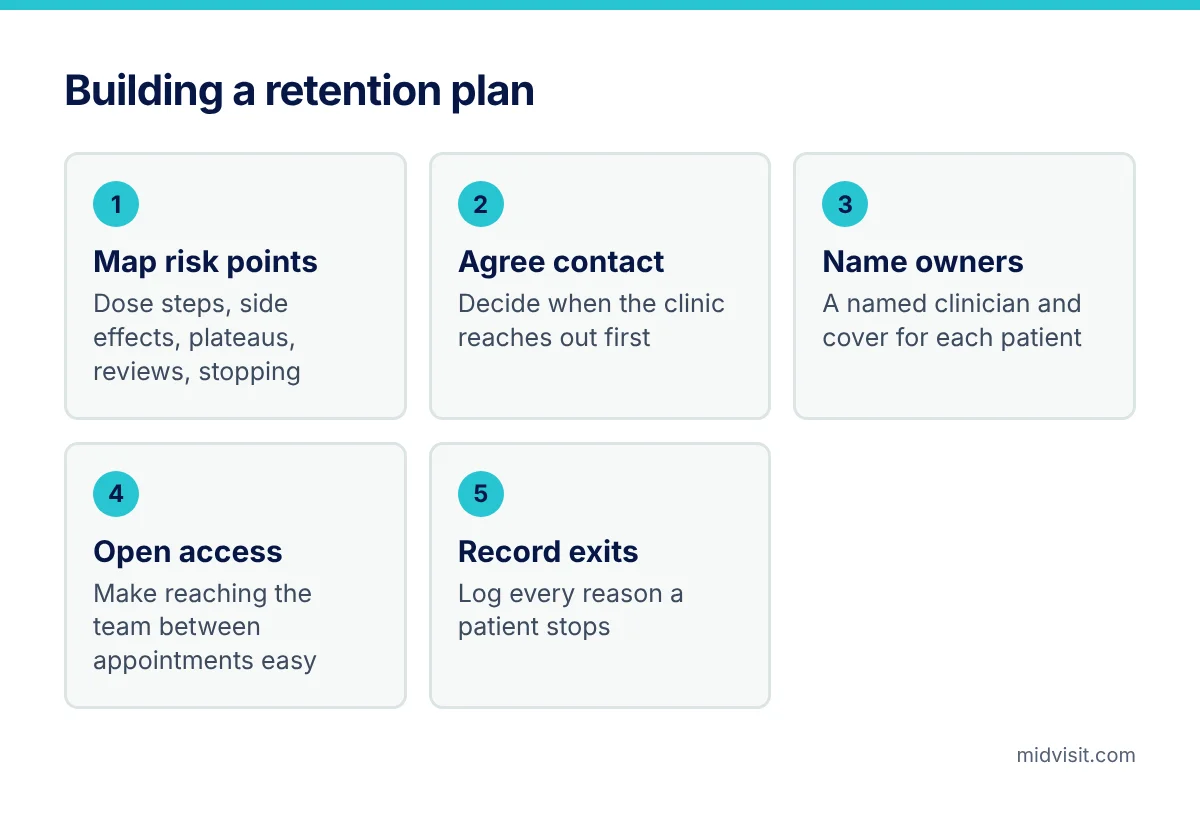
A retention plan is a set of agreed contact points, owners and responses. The clinical content is for your prescribers to decide. These questions help you get the decisions made and written down.
NICE's prescribing guide offers a starting point for the last question. It suggests looking at why the patient stopped, how much weight they lost and how well they engaged with diet and activity support (NICE).
How should a weight loss clinic measure patient retention?
Measure retention in care at fixed points, and record the reason every time a patient leaves. A single headline figure hides the difference between a good clinical decision to stop and a patient who simply drifted away.
We recommend tracking these four measures for each group of patients who start in the same month. Each is a simple ratio you can fill in from your own records.
- Retention in care at 3, 6 and 12 months = patients still in contact with the clinic at that point / patients who started.
- Planned versus unplanned exits = patients who stopped after a recorded clinical decision / all patients who stopped.
- Contact completion = planned check-ins completed / planned check-ins due.
- Review turnaround = flagged reports reviewed within the time your team agreed / all flagged reports.
Illustrative example. Suppose S patients start in March and R are still in contact at six months. Retention in care at six months is R / S. If P of the patients who left did so after a recorded decision with their prescriber, and U left without one, then P / (P + U) shows how much of your dropout is planned. A rising U is the number to act on. All values are yours to fill in; this example uses no real data.
What should clinics avoid when trying to retain patients?
Retention efforts must never push patients towards medicine they should not be taking. UK rules on prescribing and promotion set clear limits.
- Incentives for prescribers. GPhC guidance says arrangements with prescribers must not create conflicts of interest, for example incentives to issue prescriptions. Incentives or targets must not put patient safety at risk or affect professional judgement (GPhC, 2025).
- Promotional contact. The same guidance reminds providers to follow the law and guidance on advertising and promoting medicines. Follow-up calls should be about care, not sales.
- Checking eligibility by phone. The GPhC says verifying weight by phone would not be appropriate when supplying weight loss medicines. A friendly check-in call is not a supply review.
- Treating every exit as failure. If the clinical decision is to stop, the retention goal becomes support after stopping.
For the clinical side of follow-up, including what to ask between prescriptions, see our guide to GLP-1 patient follow-up.
Which follow-up approach suits your clinic?
The right approach depends on how many patients you follow and how much contact your team can make. Most clinics combine scheduled contact with a route for patients to get in touch themselves.
- For patient-led contact between reviews, read about patient-initiated follow-up.
- For the trade-offs between channels, see AI voice calls versus SMS reminders.
- For staff time, our manual versus automated follow-up comparison gives a cost model you can fill in.
We recommend choosing the approach after you have mapped your risk points, not before. The channel should serve the plan.
How Midvisit helps
Midvisit is an AI patient follow-up platform for private clinics. Its voice agent, Mira, calls patients between appointments and flags concerns for clinician review after each call. For weight loss clinics, Midvisit does not offer a ready-made weight loss or GLP-1 pathway. Clinics configure their own programmes and approve the questions, call schedule and alert thresholds, as described on our care programmes page. Mira can make scheduled calls at the contact points your team agrees, and staff can start calls manually. Each call produces an outcome, duration, transcript and AI-generated summary, and unanswered calls stay in the call history, which helps a team see who has gone quiet. Responses that meet configured alert criteria are routed to assigned clinicians after the call. Mira does not make clinical or prescribing decisions, and Midvisit makes no claim that it improves retention. See our clinical oversight approach for how responsibilities are shared.
FAQs
What is a good patient retention rate for a weight loss clinic?
There is no UK benchmark for private weight loss clinics. Published figures vary widely by setting. A US GLP-1 study found 64.8% of patients without type 2 diabetes stopped within a year, while a structured US programme kept 51% at two years. Track your own retention in care at 3, 6 and 12 months, and record reasons for every exit.
Why do patients stop GLP-1 weight loss injections?
In a large US study, gastrointestinal side effects were linked to a higher chance of stopping, and greater weight loss to a lower one. Among patients with type 2 diabetes, higher income was also linked to staying on treatment. UK patient interviews add relationship factors, such as changes of clinician and difficulty reaching the team between appointments.
Do patients regain weight after stopping GLP-1 medicines?
Most do. A 2026 BMJ systematic review found an average regain of 0.4 kg a month after stopping weight management medicines, with a projected return to starting weight in about 1.7 years. NICE's prescribing guide says clinics should keep offering support to help patients maintain the weight they lost.
Should clinics try to keep every patient on medication?
No. NICE uses six months as a review point and expects a decision on continuing if less than 5% of initial weight has been lost. Stopping can be the right clinical outcome. Good retention means keeping patients in care and supported, whether or not they continue the medicine.
How can a weight loss clinic reduce patient dropout?
Start by mapping when dropout happens: dose increases, side effects, plateaus, clinician changes and the six-month review. Then agree with your clinical team when the clinic will make contact, who owns each patient and how patients can reach the team. Record why each patient leaves, so you can see which exits were planned.
Can follow-up calls be used to sell more treatment?
They should not be. GPhC guidance warns against incentives for prescribers to issue prescriptions and reminds providers to follow the rules on advertising medicines. Follow-up contact should be about the patient's care, side effects and progress, with prescribing decisions left to the prescriber after a proper review.
Does Midvisit offer a weight loss retention programme?
Not as a ready-made product, and Midvisit makes no claim about retention outcomes. Clinics can configure their own programmes with approved questions, call schedules and alert thresholds. Mira calls patients at the agreed points, and responses that meet alert criteria are routed to assigned clinicians after the call.