
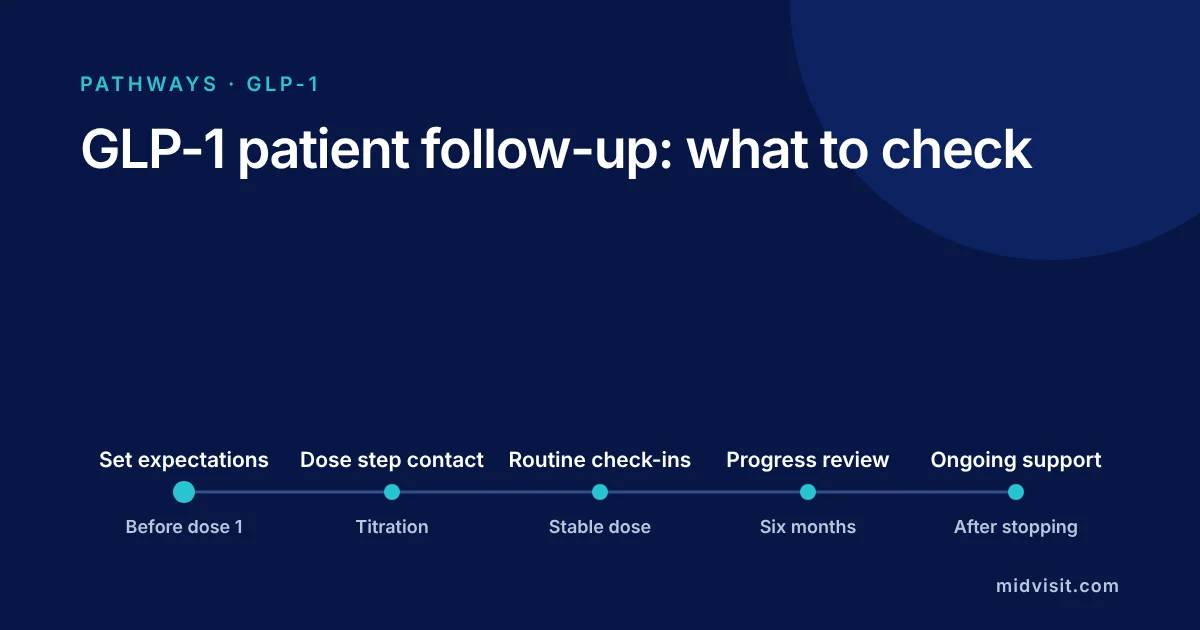
GLP-1 patient follow-up is structured contact with patients taking semaglutide or tirzepatide between prescriptions. NICE's prescribing guide lists what to cover: injection problems, side effects, pregnancy plans and contraception, diet and activity support, weight and related conditions. A prescriber then decides whether to continue, increase, reduce or stop the dose.
Patients on GLP-1 medicines inject at home once a week. On tirzepatide, the dose usually steps up every 4 weeks until it is stable. Between those steps, many patients only speak to the clinic when they reorder. This guide sets out what to check in that gap, what UK regulators expect, and the questions your clinical team should answer before you design a follow-up plan.
It is written for owners, prescribers and practice managers at UK private clinics. It sits within our care programmes and follow-up pathways and focuses on medicines for weight management. It is general information, not prescribing advice.
What is GLP-1 patient follow-up?
GLP-1 patient follow-up is planned contact between prescriptions to find out how a patient is getting on with their medicine. It collects what the patient reports, records it and routes anything concerning to a prescriber.
GLP-1 receptor agonists (GLP-1s) mimic a hormone released after eating and help people feel fuller. In the UK, semaglutide (Wegovy) and tirzepatide (Mounjaro) are licensed for weight management alongside a reduced-calorie diet and exercise. Ozempic and Rybelsus are licensed for diabetes, not weight loss (MHRA).
Follow-up is different from the prescribing consultation. The consultation decides whether to prescribe. Follow-up is the steady flow of information that lets the prescriber decide whether to continue, titrate or stop.
Why does follow-up between prescriptions matter?
Most of what can go wrong with a GLP-1 medicine happens at home, between appointments. Four findings explain why clinics should plan that time carefully.
- Side effects peak during dose increases. NICE's prescribing guide says nausea, vomiting and diarrhoea are usually more common while the dose is being increased, and decrease over time (NICE).
- Some side effects become serious. The MHRA says gastrointestinal effects sometimes lead to severe dehydration needing hospital care. Acute pancreatitis is infrequent but has been reported with serious or fatal outcomes (MHRA).
- Many patients stop early. In a US cohort of 125,474 adults starting a GLP-1, 64.8% of those without type 2 diabetes stopped within a year, as did 46.5% of those with it. Moderate or severe gastrointestinal side effects were linked to a higher chance of stopping (Rodriguez et al., JAMA Network Open, 2025).
- Stopping usually means regain. A systematic review of 37 studies found people regained an average of 0.4 kg a month after stopping weight management medicines. They were projected to return to their starting weight in about 1.7 years (The BMJ, 2026).
The US cohort was drawn from US health systems, where insurance shapes access, so its rates may not match a UK private clinic. The direction is still useful: side effects and slow progress are the moments when patients are most likely to stop.
What should clinics check between GLP-1 prescriptions?
NICE's prescribing guide lists what to discuss and record at each follow-up during titration. The MHRA adds safety points that patients should be reminded of. Your prescribers should turn these into the exact questions for your service.
| Area | What to ask about | Why it is on the list |
|---|---|---|
| Injections | Any difficulty using the pen, missed or late doses | NICE lists injection difficulties as a follow-up item |
| Side effects | Nausea, vomiting, diarrhoea, constipation, whether they can keep fluids down | NICE and the MHRA both flag dehydration risk |
| Warning symptoms | Severe stomach pain that spreads to the back; sudden changes in eyesight | The MHRA names pancreatitis and, for semaglutide, a rare eye condition (NAION) |
| Pregnancy and contraception | Plans for pregnancy; oral contraceptive use after starting or increasing tirzepatide | The MHRA and NICE set out washout periods and extra contraception |
| Upcoming procedures | Any planned surgery or sedation | The MHRA warns of aspiration risk under general anaesthesia or deep sedation |
| Diet and activity | Whether they need more support with eating and activity | NICE and both technology appraisals pair the medicine with diet and activity |
| Other medicines and conditions | Changes to diabetes or blood pressure treatment; new medicines | NICE notes these may need adjusting as weight falls |
| Progress | Changes the patient has noticed since last contact | NICE suggests discussing positive impacts to encourage the patient |
Two details matter for patients with type 2 diabetes. NICE notes that people taking insulin or a sulphonylurea may need a dose reduction to reduce hypoglycaemia risk, and that HbA1c needs closer monitoring during dose changes (NICE).
For the contraception point, the MHRA advises people taking tirzepatide with an oral contraceptive to add a barrier method for four weeks after starting and after each dose increase, or switch to a non-oral method. It recommends stopping semaglutide at least 2 months, and tirzepatide at least 1 month, before trying to conceive (MHRA).
What do UK regulators expect from private GLP-1 prescribing?
The General Pharmaceutical Council (GPhC) expects extra safeguards for weight management medicines supplied at a distance. NICE sets the NHS eligibility rules and a review point at six months. Both shape what a sensible private follow-up looks like.
GPhC guidance for services at a distance (February 2025)
The GPhC guidance for registered pharmacies providing services at a distance covers pharmacies and the online prescribing services they work with. It lists medicines used for weight management among those that need extra safeguards before they are prescribed. Key points:
- Prescribing decisions should not rest on an online questionnaire alone.
- The prescriber should independently verify weight, height and/or BMI, for example by video, in person, from clinical records or by contacting the GP. The guidance says verifying information through a phone call would not be appropriate when supplying medication for weight loss.
- The prescriber takes responsibility for making sure the necessary monitoring arrangements are in place before prescribing for conditions that need ongoing monitoring.
- Clinical records should include monitoring and follow-up plans, and relevant information should be shared with the person's GP where they consent.
If your clinic prescribes and supplies through a different route, check which regulator's standards apply to you. The principle of a recorded follow-up plan is useful either way.
NICE technology appraisals
NICE recommends semaglutide for up to 2 years within a specialist weight management service, for adults who meet BMI and comorbidity criteria. It says to consider stopping if less than 5% of initial weight is lost after 6 months (NICE TA875). For tirzepatide, NICE says that if less than 5% is lost after 6 months on the highest tolerated dose, the team should decide whether to continue (NICE TA1026).
These criteria govern NHS funding. Private clinics are not bound by them, but the 5% review point gives follow-up a clear purpose: knowing, at six months, whether the medicine is working well enough.
Questions to plan GLP-1 follow-up with your clinical team
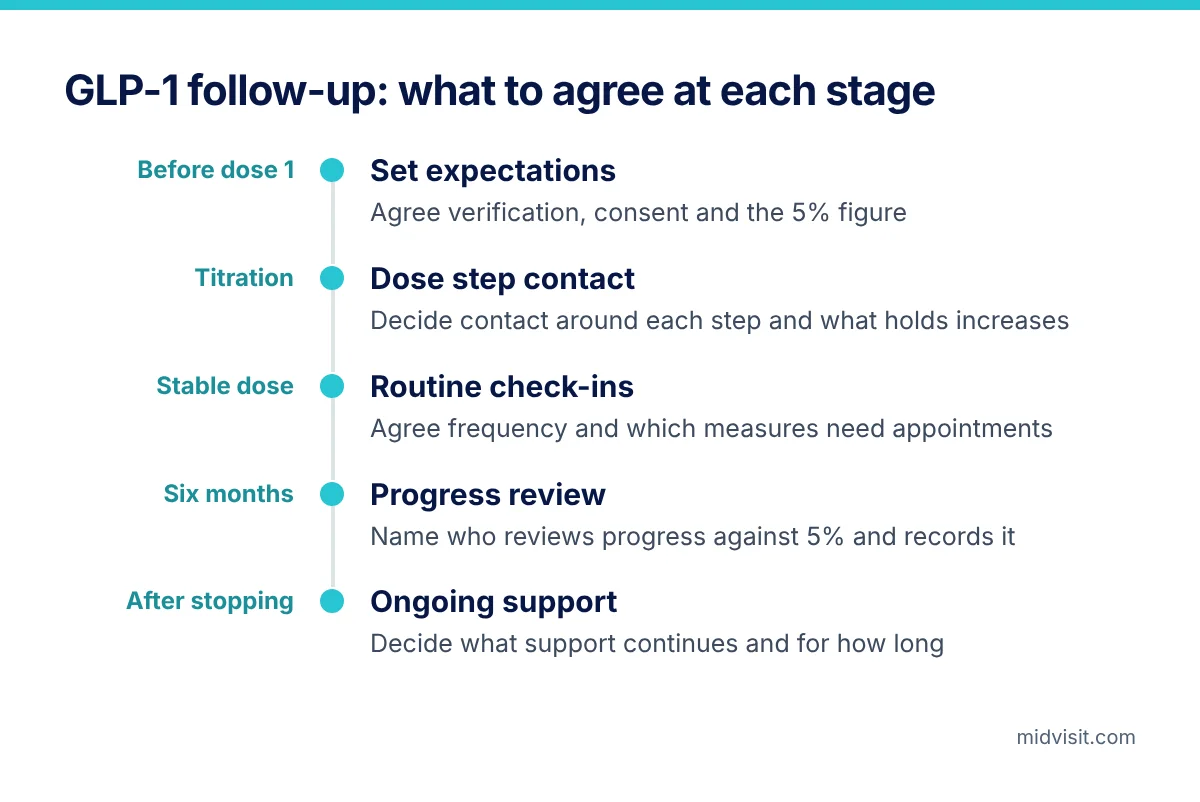
There is no single required contact schedule for private GLP-1 patients. NICE's prescribing guide says to follow up every 4 weeks during tirzepatide titration, and to follow local pathways once the dose is stable (NICE). Take these questions to your prescribers and agree the answers for each medicine and patient group.
The answers will differ between a patient starting tirzepatide with type 2 diabetes and a patient on a stable semaglutide dose. Write them into the follow-up plan your records hold for each patient.
What can a phone check-in collect, and what needs verification?
A phone check-in is good at collecting what the patient reports: symptoms, problems and questions. It is not a substitute for independent verification where a regulator asks for one. This table separates the two.
| Information | Can a phone check-in collect the patient's report? | Does it need verification elsewhere? |
|---|---|---|
| Side effects and hydration | Yes | Prescriber reviews the report and decides next steps |
| Injection problems or missed doses | Yes | Usually no; agree with your team |
| Pregnancy plans or possible pregnancy | Yes | Prescriber acts on it; NICE says stop tirzepatide if pregnancy occurs |
| Weight for a supply decision | Self-report only | Yes. The GPhC says verify by video, in person, records or GP, not by phone |
| Blood pressure | Self-report of home readings | The GPhC says consider whether readings need independent verification |
| Severe abdominal pain or sudden vision change | It may surface on a call | The patient needs urgent care, not a scheduled call. Make sure they know where to go |
In our view, the right role for phone follow-up is safety-netting and support between verified reviews. It should not be the way a clinic confirms eligibility for the next supply.
When should a GLP-1 check-in go to a prescriber?
A report should reach a prescriber whenever it meets criteria your clinical team has agreed in advance. Software should apply those criteria the same way every time. It should not make up its own.
Severe symptoms need urgent care, not the next scheduled call. The MHRA tells patients with severe stomach pain that spreads to the back to seek urgent medical help. Every follow-up contact is a chance to repeat that message.
How does follow-up help patients stay on track?
Follow-up is also how clinics keep patients engaged through the hard weeks. In the US cohort, greater weight loss was linked to a lower chance of stopping, while gastrointestinal side effects were linked to a higher one (JAMA Network Open, 2025).
That puts two moments at the centre of any plan: the first weeks of side effects, and the point where weight loss slows. Our guide to weight loss clinic patient retention looks at those moments in more detail. If you are weighing up channels for routine contact, see AI voice calls versus SMS reminders.
We recommend starting small. Run one patient group through a defined follow-up plan, then review answer rates, flagged reports and what prescribers did with them. Our guide on how to run a 90-day remote monitoring pilot sets out how.
How Midvisit helps
Midvisit is an AI patient follow-up platform for private clinics. Its voice agent, Mira, calls patients between appointments and flags concerns for clinician review after each call. Midvisit does not offer a ready-made GLP-1 pathway. Clinics configure their own programmes with us and approve the questions, call schedule and alert thresholds, as described on our care programmes page. Mira asks the structured questions in that configured pathway, in English, on scheduled, staff-started or alert-triggered calls. Each call produces an outcome, duration, transcript and AI-generated summary, and unanswered calls stay in the call history. Responses that meet the clinic's alert criteria are routed to assigned clinicians after the call, and the reviewing clinician can call the patient back from the alert and record a note. Mira does not make prescribing decisions, and a Mira call is not a way to verify weight for supply. Midvisit is not an emergency service, as set out in our clinical oversight approach. See how Midvisit works for the full flow.
FAQs
How often should GLP-1 patients be followed up?
No single UK rule applies to private clinics. NICE's prescribing guide for tirzepatide suggests follow-up every 4 weeks during dose titration, then following local pathways once the dose is stable. How often your clinic makes contact, and through which channel, is for your prescribers to decide for each medicine and patient group.
What should a GLP-1 follow-up check cover?
NICE's prescribing guide lists injection difficulties, side effects, pregnancy plans, the need for diet and activity support, and changes the patient has noticed. It also covers weight, BMI and measures for related conditions such as blood pressure. The MHRA adds reminders about dehydration, pancreatitis symptoms, contraception and telling the anaesthetist before surgery.
Can weight be checked by phone for a GLP-1 prescription?
Not for a supply decision under GPhC guidance. The GPhC says prescribers should independently verify weight, height and/or BMI for weight management medicines, for example by video, in person, from records or via the GP. It states that verifying information through a phone call would not be appropriate when supplying medication for weight loss.
When should GLP-1 treatment be reviewed for effectiveness?
NICE uses six months as the review point. For semaglutide, it says to consider stopping if less than 5% of initial weight is lost after 6 months. For tirzepatide, it says to decide whether to continue if less than 5% is lost after 6 months on the highest tolerated dose, weighing benefits and risks.
What happens when patients stop GLP-1 medicines?
Most regain weight. A 2026 BMJ systematic review found an average regain of 0.4 kg a month after stopping weight management medicines, with a projected return to starting weight in about 1.7 years. NICE's prescribing guide says clinics should continue to offer support to help patients keep off the weight they lost.
Which GLP-1 side effects need urgent attention?
The MHRA says severe stomach pain that spreads to the back and does not go away can signal pancreatitis and needs urgent help. Sudden changes in eyesight on semaglutide should be reported to a doctor urgently. Vomiting or diarrhoea can lead to severe dehydration. Patients should know where to go out of hours, not wait for a scheduled call.
Does Midvisit offer a GLP-1 follow-up pathway?
Not as a ready-made product. Midvisit's live pathway is post-procedure check-in, and type 2 diabetes check-ins are available for pilot. Clinics can configure their own programmes and approve the questions, call schedule and alert thresholds. The clinic's prescribers stay responsible for clinical content, review and every prescribing decision.