
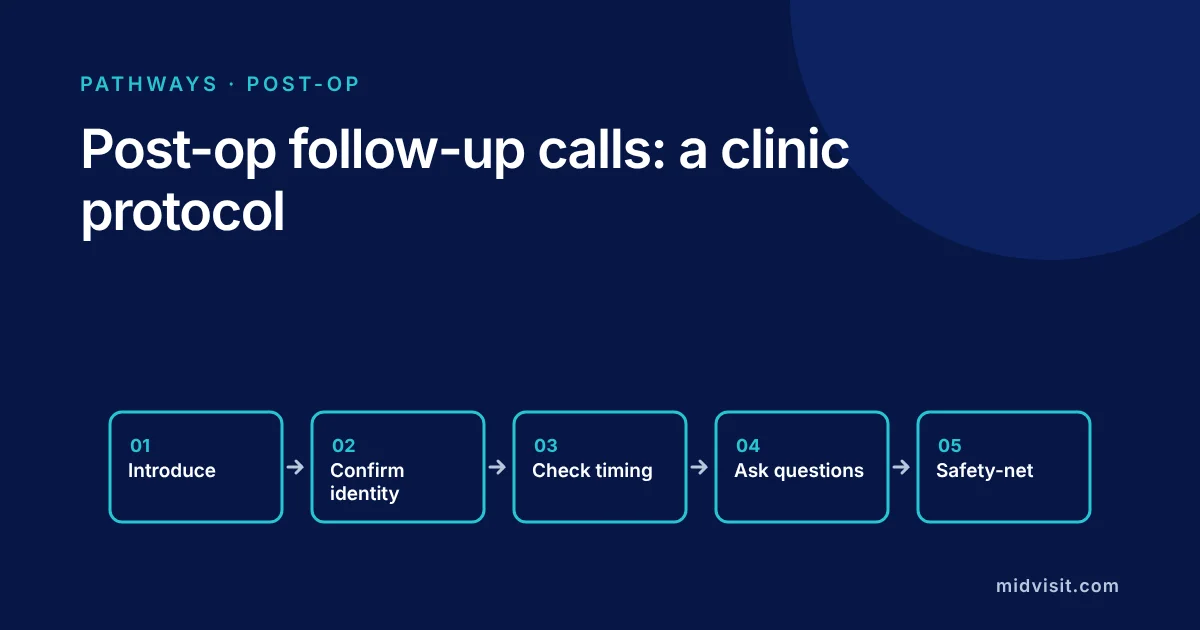
A post operative follow up call is a planned phone call to a patient at home after a procedure. It follows a set structure: introduce the call, confirm identity, ask the questions your clinical team has approved, invite concerns, remind the patient who to contact, and record the outcome. The protocol matters as much as the questions.
Most private clinics already phone some patients after surgery. Fewer have written down how that call should run: who is called, how identity is checked, what happens when nobody answers and where the record goes. This guide sets out a call protocol you can adapt. It sits within our care programmes for patients between appointments.
It is deliberately about the call itself. For what to track in the first fortnight and how often to make contact, read our companion guide to post-operative remote monitoring in the first 14 days.
What is a post-operative follow-up call?
A post-operative follow-up call is a planned phone call to a patient after a procedure, usually once they are home. It collects what the patient reports, gives them a chance to ask questions and creates a record the care team can review.
It is narrower than remote monitoring. Monitoring is the whole programme of contact, which may include apps, wound photos or devices. The follow-up call is one tool within it, and often the first one a private clinic uses because it needs no equipment.
Calls can be made by a nurse, a healthcare assistant working to a script, or an automated voice agent. Whoever makes the call, the same protocol questions apply: who is called, what is asked, what is recorded and who reviews it.
Why do private clinics make follow-up calls after surgery?
Clinics call because patients go home with questions and the first days are when uncertainty is highest. A call also gives the clinic a structured way to meet expectations that already exist in national guidance.
- A point of contact. NICE guideline NG180 on perioperative care recommends that patients have a point of contact in the perioperative team for information and support before and after surgery (recommendation 1.1.1).
- Infection advice. NICE guideline NG125 asks teams to tell patients how to recognise a surgical site infection and who to contact if they are worried (recommendation 1.1.3). A call can check whether that advice was understood.
- Continuity. The Royal College of Surgeons' Good Surgical Practice asks surgeons to make sure the patient knows the name of the person responsible for their care.
Patients appear to value the contact. In a 2025 qualitative study, day surgery patients described follow-up calls as necessary for continuity of care and for supporting self-care at home. A systematic review of telemedicine after surgery found high patient satisfaction across the studies it included.
The safety evidence is thinner. Authors of a randomised trial comparing telephone and face-to-face follow-up in general surgery noted that evidence on safety and efficacy after surgery is limited. In our view, that is a reason to treat the call as structured safety-netting, agreed with your surgeons, rather than a replacement for planned clinical review.
What should a post-operative follow-up call include?
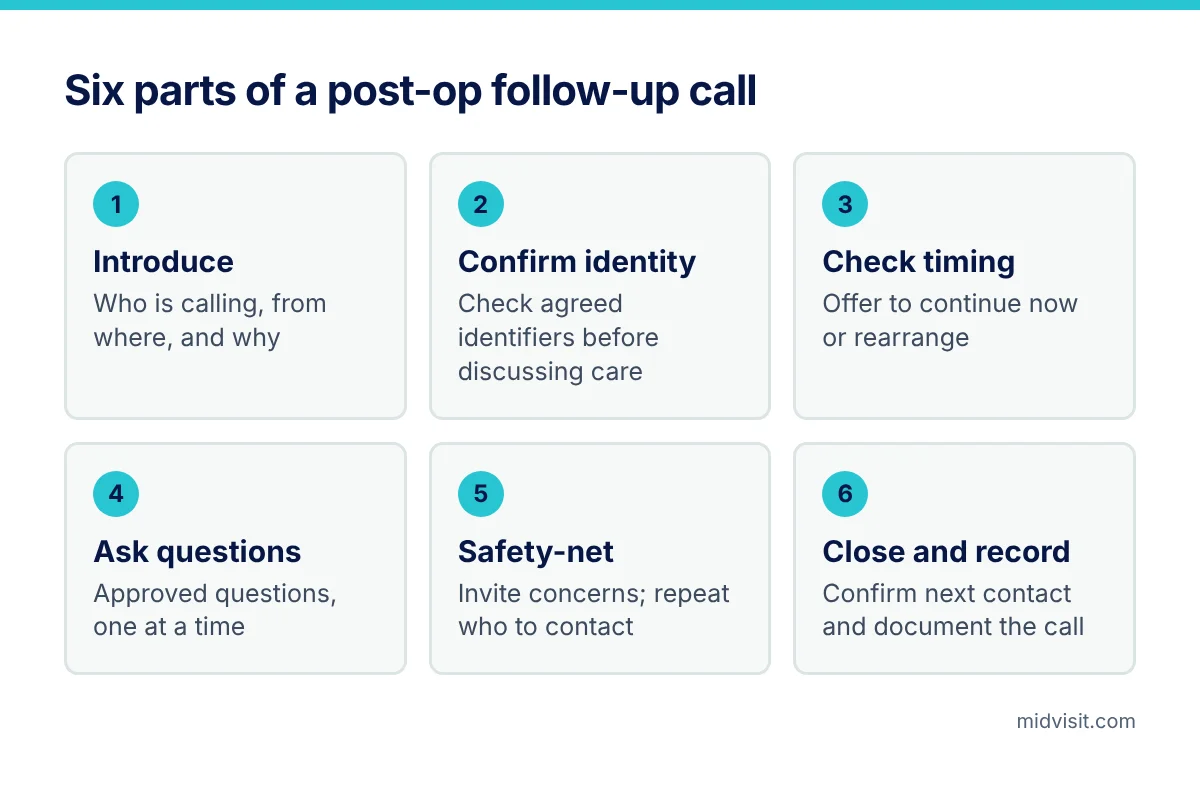
A good call follows the same six parts every time. The content of each part is set by your clinical team; the structure keeps calls consistent whoever, or whatever, makes them.
| Part | Purpose | What to agree in advance |
|---|---|---|
| 1. Introduce | Say who is calling, from which clinic and why | The opening wording, and whether the caller says the call is recorded or automated |
| 2. Confirm identity | Make sure you are speaking to the right person before discussing their care | Which identifiers to check and what to do if someone else answers |
| 3. Check it is a good time | Give the patient a choice to continue or rearrange | How a rearranged call is booked and recorded |
| 4. Ask the approved questions | Collect the patient's report in a consistent order | The question set for each procedure, signed off by the surgeon |
| 5. Invite concerns and safety-net | Hear what the patient wants the team to know and remind them who to contact | The safety-net wording, including what to do out of hours or in an emergency |
| 6. Close and record | Confirm next contact and document the call | Where the record lives and who reviews it |
Part 4 is where most clinics start, but parts 2, 5 and 6 are where calls tend to go wrong. A missed identity check, a vague safety-net or a call that never reaches the record can undo a well-written question set.
What questions go in part 4?
The questions should come from your existing discharge advice so the patient hears one consistent message. Common domains after surgery are pain, the wound, temperature and medicines, plus an open question for anything else. Our post-operative monitoring guide explains why each domain matters. The exact wording, and which answers need review, belong to your surgeons.
How should you confirm a patient's identity on a follow-up call?
Confirm identity before discussing anything about the procedure. A wrong-person call can disclose confidential health information, and a third party answering is common when patients are recovering at home.
GMC confidentiality guidance reminds doctors that communication methods carry a risk of interception and that they should take reasonable steps to make sure the methods they use are secure. It also says identifiable information should not be shared where it can be overheard.
How do you write a post-op follow-up call script?
A good script is short, plain and approved. It should sound like your clinic and use the words patients heard at discharge. Here are the wording principles we recommend, based on our experience of building structured check-ins; they are operational advice, not clinical guidance.
- One question at a time. Avoid asking about pain and swelling in the same sentence. Patients answer the last part.
- Neutral wording. “How is your pain today?” invites a truer answer than “Your pain is better, isn't it?”
- Closed, then open. Ask the set question, then let the patient add detail in their own words.
- Plain language. Say “the area where you had your operation” if patients may not know the word incision.
- Name the limits. Patients should hear that the caller cannot diagnose or change treatment, and that a clinician reviews what they say.
- End with the safety-net. Repeat who to contact and what to do in an emergency, in the wording your team approved.
A synthetic example of an opening, for illustration only: “Hello, this is a call from [clinic] to check how you are getting on after your procedure. Before we start, can you confirm your full name and date of birth?” Your team should approve the actual wording.
If you are weighing a call against a text message for this contact, our comparison of AI voice calls and SMS reminders sets out the trade-offs.
What should happen when a patient does not answer?
Decide this before the first call. An unanswered call is information in its own right: the patient may be resting, may have the wrong number on file or may be unwell. Without a rule, missed calls quietly drop out of the process.
Voicemail needs care. The GMC notes that messages left on answering machines can be heard by others, so a message should not reveal the procedure or other health details unless the patient has agreed to that.
Patients calling in is part of the same system. If your clinic is also building a route for patients to make contact when they need to, see our guide to patient-initiated follow-up.
How should a follow-up call be documented?
Every call, answered or not, should leave a record a colleague can pick up. Professional standards already expect this of registered staff.
The NMC Code asks nurses and midwives to complete records at the time or as soon as possible after an event, and to make sure entries are clearly attributed, dated and timed (section 10). Good Surgical Practice asks that notes give enough detail for another doctor to continue care.
For a follow-up call, a useful record includes:
- the date, time and duration of the call, and who or what made it
- whether identity was confirmed
- the patient's answers to each approved question, in their own words where it matters
- any concern the patient raised and any question for the team
- whether the safety-net advice was given
- who reviewed the record, what they decided and when
If calls are recorded or transcribed, tell patients at consent and again at the start of each call. We recommend checking this with whoever leads data protection in your clinic before the first call.
Questions to agree with your clinical team before the first call
The protocol above is the frame. The clinical content inside it is for your surgeons and nurses to decide, procedure by procedure. Take these questions to them before you start.
Start with one procedure and one surgeon, then expand once the team trusts the calls. Our guide to running a 90-day remote monitoring pilot covers scope, success measures and governance.
How Midvisit helps
Midvisit is an AI patient follow-up platform for private clinics. Its voice agent, Mira, calls patients between appointments and flags concerns for clinician review after each call. With post-procedure check-in, the clinic enrols each patient in an agreed pathway and agrees suitability, consent, call timing and review ownership. Mira phones the patient in English and asks the structured questions set by that pathway, covering pain, the wound site, reported temperature and medication.
Calls can be scheduled, started manually by staff or triggered by a configured alert. Each call produces an outcome, duration, transcript and AI-generated summary, and unanswered or interrupted calls stay in the call history. After the call, responses that meet the clinic's configured alert criteria are routed to assigned clinicians, who can call the patient back from the alert and record a note. Mira does not make clinical decisions or change questions during a call; see our clinical oversight approach for the boundaries.
FAQs
What is a post-operative follow-up call?
It is a planned phone call to a patient after a procedure, usually once they are home. The caller confirms identity, asks questions the clinical team has approved, invites concerns, reminds the patient who to contact and records the outcome. It is one part of post-operative follow-up, alongside any appointments, apps or devices the clinic uses.
When should a post-operative follow-up call be made?
We have not found a single UK rule that sets the timing for private clinics. The right timing depends on the procedure and the patient, so it is a decision for your surgeons and nurses. Agree it before calls begin, write it into the pathway, and review it once you see how patients respond and what the calls pick up.
What questions should a post-op follow-up call ask?
Most clinics cover pain, the wound, temperature and medicines, then ask an open question for anything else. The exact questions should come from your existing discharge advice and be signed off by the surgeon for each procedure. Ask one question at a time, use neutral wording and finish by repeating who the patient should contact if they are worried.
How do you confirm identity on a follow-up call?
Agree a fixed check before calls start, such as full name and date of birth, and do not discuss the procedure until it is passed. Decide in advance what the caller says if a family member answers and whether a named carer may speak for the patient. GMC guidance asks doctors to take reasonable steps to keep communication methods secure.
What should you do if the patient does not answer?
Follow a rule agreed in advance: how many attempts, how far apart and what may be left on voicemail. The GMC notes that answering machine messages can be heard by others, so avoid health details unless the patient has agreed. Record every attempt, and decide which patients need a clinician to review repeated non-contact.
Can an AI voice agent make post-operative follow-up calls?
An AI voice agent can make structured check-in calls using questions the clinic has approved, and record the answers for clinician review. It should not diagnose, change treatment or be presented as an emergency service. The clinic stays responsible for which patients are suitable, what is asked, which answers prompt review and who reviews them.
How should a follow-up call be documented?
Record the date, time and who or what made the call, whether identity was confirmed, the patient's answers, any concerns raised, whether safety-net advice was given, and who reviewed it and what they decided. The NMC Code asks for records to be completed at the time or as soon as possible afterwards, and to be dated, timed and attributed.