

Remote weight monitoring means tracking a patient's weight, symptoms and treatment between clinic visits, using home readings, apps or check-in calls. In UK weight management clinics, it supports NICE's advice to review weight-loss medicines regularly. It does not replace the independent weight checks the GPhC expects before prescribing.
This guide is for UK weight management clinics prescribing weight-loss medicines. It covers what to track between appointments, what NICE, the MHRA and the GPhC expect, and how to plan escalation with your prescriber.
What is remote weight monitoring?
Remote weight monitoring is the structured tracking of a patient's weight, symptoms and treatment between clinic appointments. Readings come from home scales, an app, a text reply or a check-in call, and the clinic reviews them against thresholds it has agreed in advance.
It is one of our follow-up solutions for private clinics. In weight management clinics, the usual trigger is a prescription. Patients starting a weight-loss medicine, such as tirzepatide (Mounjaro) or semaglutide (Wegovy), need review between visits, and much of that contact can happen without a trip to the clinic.
GLP-1 medicines are prescription medicines that help people feel fuller by mimicking a hormone released after eating. Tirzepatide also acts on a second hormone involved in appetite and blood sugar.
Remote weight monitoring usually covers three things:
- Progress: the weight trend against the starting weight.
- Safety: side effects and red-flag symptoms.
- Treatment: doses taken, dose changes and events that change the safety picture, such as pregnancy plans or upcoming surgery.
Why does remote monitoring matter for patients on weight-loss medicines?
NICE recommends regular review for anyone prescribed a weight management medicine. Its guideline NG246 asks clinicians to monitor the effect of the medicine and to reinforce behavioural advice and adherence through regular review. Remote check-ins make that review workable between appointments.
NG246 also sets clear decision points. Each one depends on knowing how much weight the patient has lost since they started.
| Medicine | NICE review point in NG246 |
|---|---|
| Tirzepatide | If less than 5% of initial weight is lost after 6 months on the highest tolerated dose, decide whether to continue, weighing benefits and risks |
| Semaglutide | Consider stopping if less than 5% of initial weight is lost after 6 months |
| Liraglutide | Stop after 12 weeks on the 3.0 mg/day dose if at least 5% has not been lost |
| Orlistat | Stop after 12 weeks if at least 5% has not been lost |
These review points were written for NHS care. We recommend private clinics use them as a benchmark, and plan the data they need well before the 6-month mark. A review based on one weight reading taken on the day is far weaker than one based on a monthly trend.
NICE also says all weight management medicines should be used alongside a reduced-calorie diet and more physical activity. It recommends support to maintain weight loss for people who stop a medicine. Both of those need contact between visits, not just at them.
For patients who also have type 2 diabetes, NICE notes that weight loss may be slower and goals should be reviewed regularly. If your clinic runs follow-up for type 2 diabetes, the two pathways should share one view of the patient.
What should a clinic track between appointments?
A clinic should track the weight trend, common side effects, red-flag symptoms, adherence and any change that affects safety, such as pregnancy or surgery. The table below links each item to its source.
| What to track | Why it matters | Source |
|---|---|---|
| Weight trend | Shows progress towards the 6-month review point | NICE NG246 |
| Nausea, vomiting, diarrhoea | The most common side effects; they sometimes lead to severe dehydration needing hospital care | MHRA |
| Severe stomach pain spreading to the back that does not go away | The main symptom of acute pancreatitis, a rare but serious risk that needs urgent medical help | MHRA |
| Sudden change in eyesight (semaglutide) | Very rare reports link semaglutide to NAION, a serious eye condition affecting vision | MHRA |
| Pregnancy plans or possible pregnancy | GLP-1 medicines should not be taken in pregnancy or just before trying to conceive | MHRA |
| Contraception (tirzepatide) | Tirzepatide may reduce the effectiveness of oral contraceptives in people living with overweight or obesity | MHRA, NICE |
| Upcoming surgery or sedation | Slower stomach emptying raises the risk of aspiration under general anaesthesia or deep sedation | MHRA |
| Doses taken, missed or changed | NICE asks for review of adherence; switching between GLP-1 medicines should involve a healthcare professional | NICE, MHRA |
| Diet and activity | Medicines are meant to be used with a reduced-calorie diet and more physical activity | NICE NG246 |
For tirzepatide, the MHRA advises people on the pill to add a barrier method for four weeks after starting and after each dose increase, or to switch to a non-oral method. NAION stands for non-arteritic anterior ischaemic optic neuropathy, the eye condition named in the MHRA warning.
Can a phone call verify a patient's weight?
No. The General Pharmaceutical Council (GPhC) says verifying information through a phone call is not appropriate when supplying weight-loss medication. Prescribers must independently verify weight, height and/or BMI, for example by video consultation, in person, from clinical records or by contacting the patient's GP.
The GPhC's weight management FAQs add a nuance for repeat supplies. Once the initial weight has been verified by other means, a photo or recording may sometimes be acceptable for a later prescription. There must still be a way to check how weight loss is progressing and to verify it periodically.
This guidance applies to GPhC-registered pharmacies, including online services and pharmacist prescribers. Clinics regulated elsewhere should check their own regulator's expectations, but the GPhC position is a sensible benchmark for any service supplying these medicines.
It has three practical consequences for remote monitoring:
- Patient-reported weights from a call, text or app are useful for spotting trends and problems early.
- They are not a substitute for verified readings where the prescriber needs one.
- Verified readings should be planned into the pathway, for example at the start, before key dose decisions and at the 6-month review.
How often should a clinic check in with weight management patients?
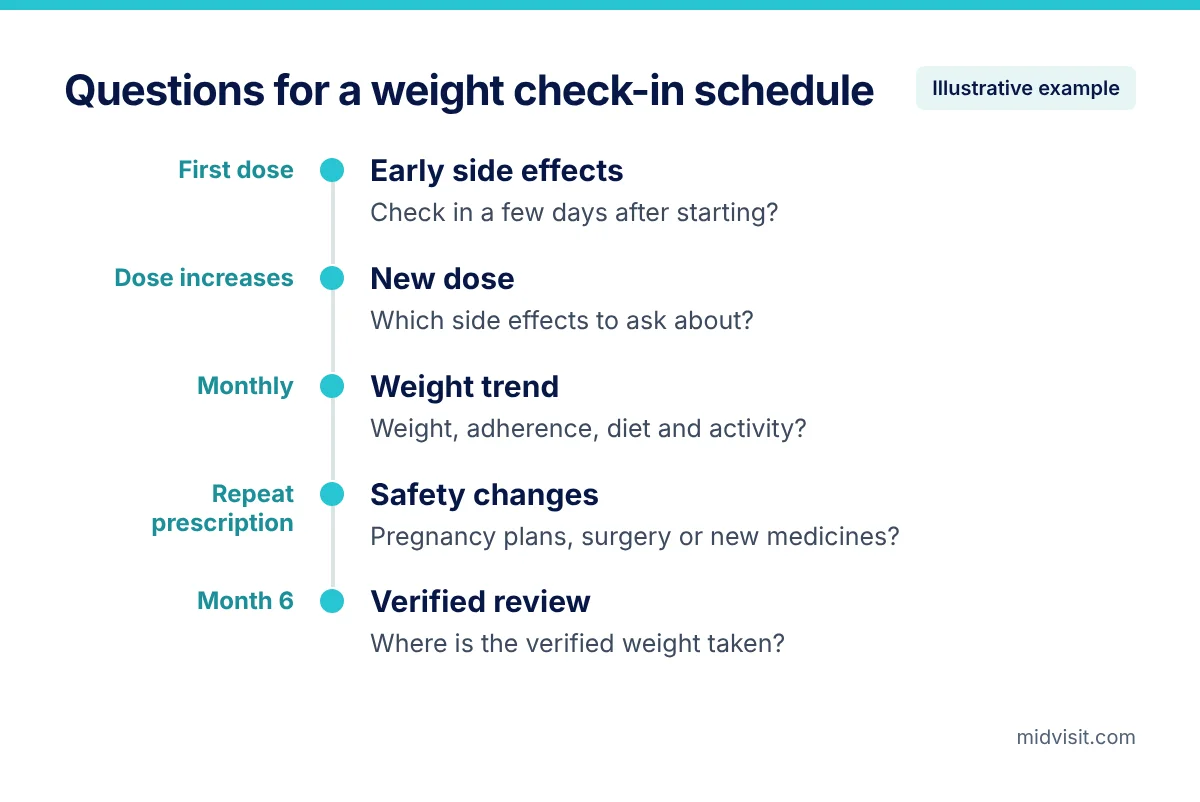
There is no single national schedule for private clinics. A useful question for your prescriber is whether to tie contact to the moments when risk changes or a decision is due: starting treatment, each dose increase, each repeat prescription and the 6-month review.
Illustrative example: a check-in template to discuss with your prescriber
This is an illustrative example to start that conversation, not a clinical protocol or a Midvisit recommendation. Your prescriber sets the final timing, questions and thresholds.
| When | Purpose | Example check-in questions |
|---|---|---|
| A few days after the first dose | Early side effects | "Have you had nausea, vomiting or diarrhoea? Are you able to keep fluids down?" |
| A few days after each dose increase | Side effects at the new dose; contraception reminder where relevant | "How have you felt since the higher dose? Any new symptoms?" |
| Monthly | Weight trend, adherence, diet and activity | "What did your scales show this week? Have you missed any doses?" |
| Before each repeat prescription | Confirm nothing has changed | "Any pregnancy plans, planned operations or new medicines?" |
| Month 6 | Review against the agreed goal, with a verified weight | Booked review with the prescriber |
| On stopping | Support to maintain weight loss | "How are you finding things since stopping?" |
The questions are deliberately short and closed. They are easy to answer on a call and easy to compare month to month. Our guide to GLP-1 patient follow-up goes deeper into the prescription cycle.
When should a check-in go to a clinician?
Any answer that might need a clinical decision should reach a named clinician. Before the first patient is enrolled, ask your prescriber which answers belong in which tier, so nobody improvises under pressure. The table is an illustrative example to start that discussion.
| Tier | Example answers | What happens |
|---|---|---|
| Urgent | Severe stomach pain spreading to the back that does not go away; sudden change in eyesight on semaglutide; unable to keep fluids down | Patient told to seek urgent medical help now; clinician alerted |
| Prompt review | Possible pregnancy; persistent sickness or diarrhoea; operation booked; switched brand or dose without advice; low mood or worries about eating | Clinician reviews and calls back within the clinic's agreed time |
| Routine | Weight trend off track; questions about diet or activity | Reviewed at the next scheduled contact |
How do you set up remote weight monitoring in a clinic?
Start with the pathway, not the technology. A clear pathway tells you which channel, cadence and alert rules you need.
- Define who is enrolled. For example, every patient starting or changing a weight-loss medicine.
- Agree consent. Patients should know how they will be contacted, what is recorded and who sees it.
- Write the pathway. Set the cadence, the questions and the thresholds for each tier.
- Name the owners. Decide who reviews alerts, how fast, and who covers absences.
- Plan verified readings. Put video or in-person weight checks where the prescriber needs them.
- Set patient expectations. Explain what check-ins cover and what to do in an emergency.
- Review the pathway. Look at missed calls, alert volumes and patient feedback after the first cohort.
Where do AI voice check-ins fit in weight management?
AI voice check-ins suit patients who ignore apps or texts but will answer the phone. They capture symptoms in the patient's own words and can ask the same structured questions every time. They gather patient-reported information only; they do not verify weight or make clinical decisions.
| Channel | Weight data | Symptom detail | Counts as independent weight verification (GPhC)? |
|---|---|---|---|
| Home scales and app | Reading entered or synced by the patient | Limited to app forms | No |
| SMS reply | Number typed by the patient | Short replies | No |
| Voice check-in call | Number reported by the patient | Structured spoken answers | No (phone calls are not appropriate) |
| Video or in-person review | Weight seen by the clinician | Full consultation | Yes: the GPhC lists both video and in-person |
Most clinics will combine channels. A common pattern is regular patient-reported check-ins, with verified readings at the decision points.
At Midvisit, our voice agent Mira phones patients and asks structured check-in questions set by the pathway the clinic configures. After each call, responses that meet the clinic's alert criteria go to the assigned clinician, who can call the patient back and record a note. Clinical decisions stay with the care team; read more about how clinical oversight works.
How Midvisit helps
Midvisit is an AI patient follow-up platform for private clinics. Its voice agent, Mira, calls patients between appointments and flags concerns for clinician review after each call. Weight management is not a ready-made Midvisit pathway: each clinic configures the questions, timing and alert criteria with its prescriber. Mira then phones patients and asks those structured check-in questions. After each call, responses that meet the alert criteria go to the assigned clinician, who can call the patient back and record a note. Mira does not verify weight to GPhC standards and does not make clinical decisions.
FAQs
What is remote weight monitoring?
Remote weight monitoring is structured tracking of a patient's weight, side effects and treatment between clinic appointments. Readings and answers come from home scales, an app, a text reply or a check-in call. The clinic reviews them against thresholds agreed in advance, so a named clinician can act on problems before the next visit rather than finding out at it.
Does NICE say weight-loss medicines need regular review?
Yes. NICE guideline NG246 recommends monitoring the effect of weight management medicines and reinforcing behavioural advice and adherence through regular review. It also sets decision points, such as considering whether to continue semaglutide or tirzepatide if less than 5% of initial weight has been lost after 6 months. Those decisions depend on a reliable weight trend.
Can a clinic prescribe based on a weight the patient reports by phone?
Not for GPhC-registered pharmacies supplying weight-loss medicines. The GPhC says prescribers must independently verify weight, height and/or BMI, and that a phone call is not appropriate for this. Video consultation, in-person checks, clinical records or contact with the patient's GP are listed as acceptable routes. Patient-reported weights remain useful for spotting trends between verified readings.
Which symptoms should go straight to a clinician?
The MHRA highlights severe stomach pain that spreads to the back and does not go away, a possible sign of acute pancreatitis, as needing urgent medical help. For semaglutide, it advises urgent contact for a sudden change in eyesight. Persistent vomiting or diarrhoea can lead to severe dehydration. Your prescriber should agree the full list and the response for each.
How often should a weight management clinic check in with patients?
There is no single national schedule for private clinics. Questions for your prescriber include whether to make contact a few days after starting and after each dose increase, then monthly, before each repeat prescription and at the 6-month review. The prescriber should set the final timing, questions and thresholds for each pathway, and record who reviews each answer.
Why ask about pregnancy and surgery at check-ins?
The MHRA says GLP-1 medicines should not be taken in pregnancy or just before trying to conceive. Tirzepatide may also reduce how well oral contraceptives work in people living with overweight or obesity. Separately, these medicines slow stomach emptying, which raises aspiration risk under general anaesthesia or deep sedation, so the surgical team needs to know.
Can an AI voice agent replace clinician review in weight management?
No. An AI voice check-in collects patient-reported answers in a consistent, structured way and routes those that meet agreed criteria to a clinician. It does not verify weight to GPhC standards and it does not make clinical decisions. Prescribing, dose changes and responses to symptoms stay with the care team.