

A menopause symptom tracker for clinics is a structured way to record how a patient's symptoms change between appointments. It works best when it uses one validated scale, runs on a schedule built around the 3-month and annual reviews NICE recommends, and has agreed rules for which answers go straight to a clinician.
This guide is for private clinics that prescribe or review menopause treatment. It covers what to ask patients between appointments, which validated scale to use, how often to check in and which answers should reach a clinician.
What is a menopause symptom tracker for clinics?
A menopause symptom tracker is a structured record of which symptoms a patient has, how much each one bothers them, and how that changes over time. For a clinic, the tracker sits between appointments. It collects answers on a schedule and sends them to the care team, rather than leaving them in the patient's notebook.
Most search results for "menopause symptom tracker" are printable sheets and phone apps for individuals. Those help patients prepare for an appointment. This guide covers the clinic side: what to ask, how often, and what to do with the answers. It sits alongside our follow-up solutions for private clinics.
Three terms come up throughout:
- Perimenopause is the time of irregular cycles leading up to menopause, continuing until 12 months after the final period.
- Menopause is usually defined as 12 consecutive months without a period.
- Vasomotor symptoms are hot flushes and night sweats, caused by changes in blood flow to the skin.
Why track menopause symptoms between appointments?
Because NICE recommends reviewing treatment at fixed points, and a lot can change in between. NICE's menopause guideline (NG23) recommends reviewing each treatment for menopausal symptoms at 3 months to assess efficacy and tolerability, then annually unless there is a clinical reason to review sooner.
That leaves long gaps. The NHS says symptoms usually last 7 to 9 years, sometimes longer, and can change during that time. Hot flushes and night sweats may improve and be replaced by low mood and anxiety. NICE also asks clinicians to adapt treatment as symptoms change, and to take an individualised approach at every stage.
A tracker gives the clinician evidence for those decisions. It shows whether a symptom score has moved since the last review, rather than relying on what the patient remembers on the day.
Which menopause symptoms should a clinic track?
Start with the five symptom groups NICE asks clinicians to explain to patients, then add sleep and concentration. The NHS lists both among common symptoms, and they often shape how much menopause affects work and home life.
| Symptom group | Examples to ask about | Source |
|---|---|---|
| Vasomotor | Hot flushes, night sweats | NICE NG23 |
| Musculoskeletal | Joint and muscle pain | NICE NG23 |
| Mood | Low mood, anxiety, mood swings | NICE NG23, NHS |
| Urogenital | Vaginal dryness, urinary symptoms | NICE NG23, NHS |
| Sexual | Low sexual desire | NICE NG23 |
| Sleep and cognition | Difficulty sleeping, brain fog, poor concentration | NHS |
For patients on HRT, add three more items:
- Side effects since the last check-in.
- Any vaginal bleeding, and when it started relative to starting or changing HRT.
- Whether they are taking treatment as prescribed.
We recommend keeping each check-in short. Patients answer more consistently when the questions are the same every time.
Should you use a validated scale like the Greene Climacteric Scale?
Yes, if you want scores you can compare over time. A validated scale is a questionnaire that has been tested to show it measures what it claims to, reliably. Two are widely used for menopause symptoms.
| Greene Climacteric Scale | Menopause Rating Scale (MRS) | |
|---|---|---|
| Items | 21 | 11 |
| Scoring per item | 0 (not at all) to 3 (extremely) | 0 (none) to 4 (very severe) |
| Areas measured | Psychological (items 1-11), physical (12-18), vasomotor (19-20); item 21 asks about loss of interest in sex | Somatic (4 items), psychological (4), urogenital (3) |
| Completed by | The patient | The patient |
Patient.info notes that the Greene scale does not diagnose menopause or say whether treatment is needed. It measures how much symptoms bother someone, which is exactly what a between-visit tracker needs.
We recommend choosing one scale and sticking with it. Switching scales mid-pathway breaks the comparison. If a full scale feels long for every check-in, use the full version at baseline and before each review, and a short fixed subset of items in between.
How often should check-ins happen?
The anchor points are the 3-month review and the annual review that NICE recommends. Everything in between is a clinic decision, made by the clinician responsible for the pathway.
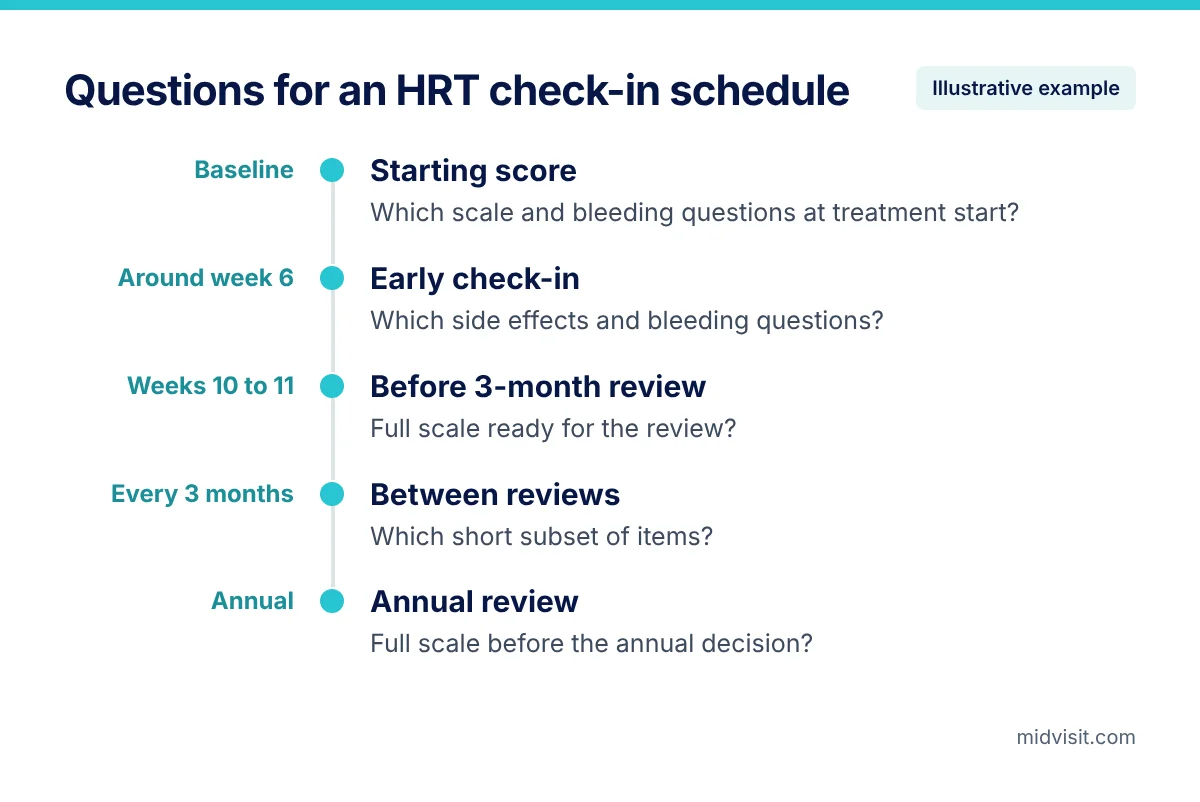
Illustrative example: a check-in schedule for a patient starting HRT
This is an illustrative schedule, not a clinical recommendation. Your clinicians set the actual timing.
| When | What to collect | Why |
|---|---|---|
| Baseline, at or before treatment start | Full scale, bleeding pattern, current treatments | Gives a starting score |
| Around week 6 | Short subset, side effects, bleeding | Catches early problems |
| Around weeks 10 to 11 | Full scale, side effects, bleeding | Results ready for the 3-month review |
| Every 3 months after the review | Short subset, side effects, bleeding | Tracks change between annual reviews |
| Before the annual review | Full scale | Supports the annual decision |
If your clinicians use a schedule like this, a check-in shortly before the 3-month review means that appointment can start from a score and a trend.
Which answers should go straight to a clinician?
Any answer the clinic would act on before the next review. Write these rules down before launch, name who reviews each one, and agree how quickly.
Unscheduled bleeding on HRT. NICE's current NG23 wording says vaginal bleeding is a common side effect during the first 6 months of systemic HRT, or within any 3 months of changing the dose or preparation. It advises people to seek medical help promptly if unscheduled bleeding happens beyond those timeframes. NICE points to the British Menopause Society guideline on managing unscheduled bleeding on HRT. Ask your clinical team whether the tracker should flag any bleeding reported outside those windows, and who reviews it.
Treatment not working, or troublesome side effects. NICE recommends referral to a healthcare professional with expertise in menopause when treatments do not improve symptoms or side effects remain troublesome. Agree with your clinical team whether a rising score or repeated side-effect reports should prompt a clinician review, and how soon.
Low mood. Mood symptoms are common. In one observational study of 1,212 new patients at a single UK menopause clinic, 16% reported thoughts of self-harm or suicidal ideation in the two weeks before their first appointment. That is one clinic's patients, not the general population. It is still a reason to plan mood questions carefully.
How should a clinic collect symptom data: paper, app or voice call?
Use whichever method your patients will complete reliably, and make sure answers reach someone who reviews them. Each method has trade-offs.
| Method | Strengths | Limits |
|---|---|---|
| Paper diary | Familiar, no technology needed | Answers arrive only at the appointment |
| Patient app or web form | Answers arrive between visits and are easy to score | Depends on the patient remembering to log |
| Scheduled voice check-in | Patient only needs to answer the phone; same questions every time | Calls can be missed; retry rules need agreeing |
Many clinics will combine methods. Midvisit's patient app lets patients report structured symptom information between visits from a browser link. Mira's scheduled check-in calls ask the approved questions on the programme's schedule. Each call produces a transcript and AI-generated summary for care-team review.
What about consent and data protection?
Menopause symptoms are health data, which UK GDPR treats as special category data. The ICO says you must identify both a lawful basis under Article 6 and a separate condition under Article 9 before processing it. Explicit consent is one Article 9 condition; health or social care is another.
In practice, settle three things before launch: the lawful basis and Article 9 condition, what patients are told about how their answers are used, and who can see the results.
Menopause follow-up checklist for private clinics
Scores collected this way also become patient-reported outcome data, which can show how a service performs over time. To see how a structured follow-up programme is set up end to end, read how Midvisit works or book a demo.
How Midvisit helps
Midvisit is an AI patient follow-up platform for private clinics. Its voice agent, Mira, calls patients between appointments and flags concerns for clinician review after each call. Menopause is not a ready-made Midvisit programme. A clinic can build its own menopause follow-up programme with its clinical team, approving the questions, call schedule and alert thresholds. Mira then asks the approved questions on that schedule, and each call produces an outcome, transcript and AI-generated summary for care-team review. Patients can also report symptoms between visits through the browser-based patient app.
FAQs
What should a menopause symptom tracker include?
It should cover the symptom groups NICE lists: hot flushes and sweats, joint and muscle pain, mood, urogenital symptoms such as vaginal dryness, and sexual difficulties. Add sleep and concentration, because the NHS lists both as common symptoms. For patients on HRT, add side effects and any bleeding pattern. Rate each item on the same scale every time so the care team can compare answers.
Is the Greene Climacteric Scale or the Menopause Rating Scale better for clinics?
Neither is better for every clinic. The Greene scale has 21 items scored 0 to 3, with psychological, physical and vasomotor sub-scores. The Menopause Rating Scale has 11 items scored 0 to 4, including a urogenital domain. Shorter scales are easier to repeat often. We recommend choosing one, confirming its terms of use, and using it at every check-in.
How often should menopause symptoms be reviewed?
NICE recommends reviewing each treatment for menopausal symptoms at 3 months to check whether it works and is tolerated, then annually unless there is a clinical reason for an earlier review. Between those points, a clinic can run shorter scheduled check-ins. The clinician responsible for the patient decides the exact schedule for each pathway.
When is bleeding on HRT a reason to escalate?
NICE says vaginal bleeding is a common side effect in the first 6 months of systemic HRT, or within 3 months of changing the dose or preparation. It advises people to seek medical help promptly if unscheduled bleeding happens beyond those timeframes. Ask your clinical team whether the tracker should flag any bleeding reported outside those windows for clinician review.
Can patients just use a menopause tracker app instead?
Patients can keep their own diary or app, and many free printable trackers exist. The limit for a clinic is that the answers stay with the patient until the next appointment. A clinic-run tracker sends answers to the care team on a set schedule, with agreed rules for which answers need a clinician to look sooner.
Do we need consent to collect menopause symptom data?
You need a lawful basis under Article 6 of UK GDPR and a separate condition under Article 9, because health data is special category data. Explicit consent is one Article 9 condition; health or social care is another. Agree the basis with your data protection lead before launch, and tell patients clearly how their answers will be used.
Can an AI voice call replace the 3-month HRT review?
No. A structured call can collect symptom answers and flag concerns, but it does not diagnose or change treatment. The review is a clinical decision point. We recommend using calls to gather answers in the weeks before the review, so the clinician starts the appointment with a score and a trend rather than a blank page.