

Patient follow-up takes more staff time than the call itself. In one published study, a structured follow-up call took a median of 8 minutes, and 10 minutes per patient once coordination was added. Preparation, unanswered attempts, notes and escalations add more, so the reliable figure is the one you measure in your own clinic.
Most clinics know how many follow-up calls they make. Far fewer know their patient follow-up time: the staff hours those calls really consume once preparation, missed attempts, notes and escalations are counted. This guide breaks that time into parts, shows what published studies measured, and gives you a two-week audit to find your own figure. It sits alongside our other guides on running a practice.
Why is patient follow-up time so hard to see?
Follow-up work is scattered across the day. A nurse makes three calls before clinic, two after lunch and chases a voicemail at 5pm, and none of it appears as a single task on a rota.
Administrative load in healthcare is large and often unmeasured. In YouGov research for NHS Shared Business Services, published in August 2026, 28% of NHS staff said they spend more than 10 hours a week on administrative tasks. Among staff affected by admin, inefficient processes or IT problems, a third said it meant less time with patients.
Private clinics are smaller, but the pattern is familiar. Follow-up calls get squeezed between appointments, and nobody adds up the minutes.
What counts as patient follow-up time?
Patient follow-up time is every minute of staff effort needed to complete one follow-up contact, from opening the notes to closing the record. The call itself is only one part.
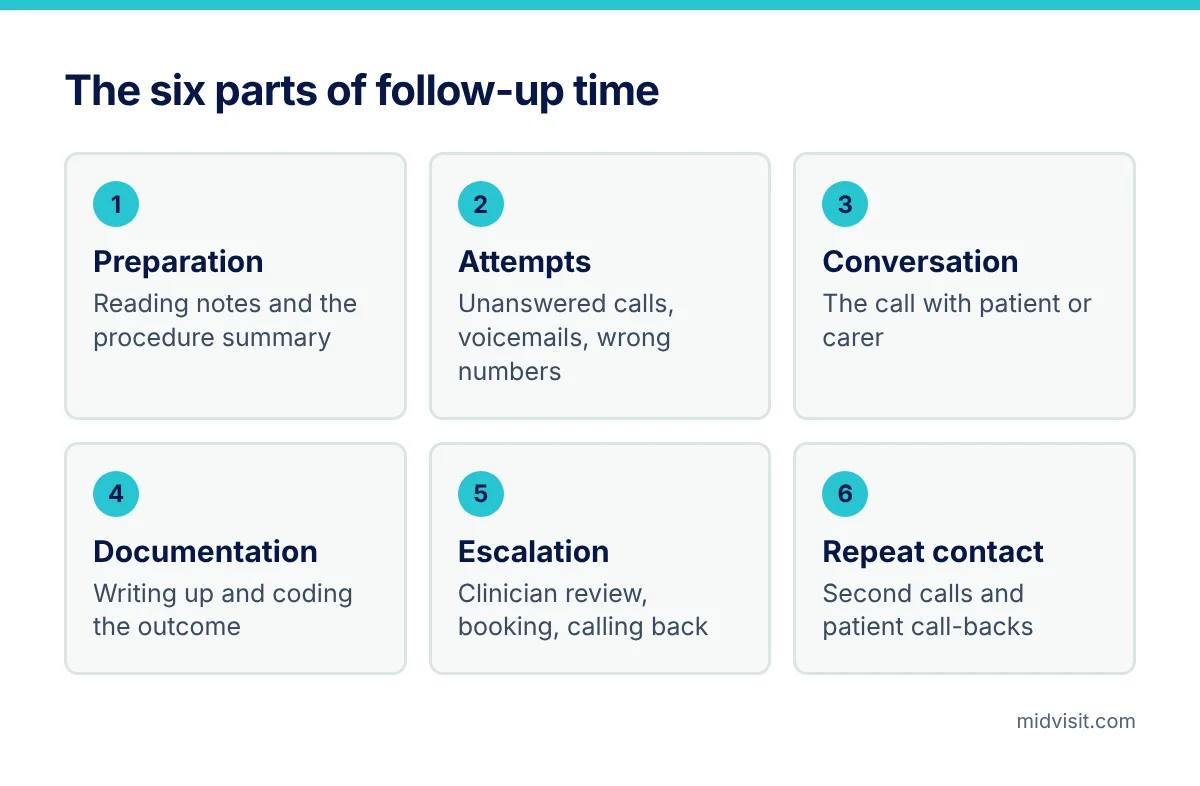
The US Agency for Healthcare Research and Quality (AHRQ) publishes a documentation form for post-discharge calls. It asks callers to record time in separate categories, including preparation, missed attempts, the call, talking to other clinicians, repeat calls and speaking with family. We have adapted those categories into six buckets for clinic use.
| Time bucket | What it includes | Usually counted? |
|---|---|---|
| 1. Preparation | Reading notes, checking the discharge or procedure summary and medicines | Rarely |
| 2. Attempts | Unanswered calls, voicemails, wrong numbers, rescheduled calls | Rarely |
| 3. Conversation | The call with the patient or carer | Usually |
| 4. Documentation | Writing up the call and coding the outcome | Sometimes |
| 5. Escalation | Speaking to a clinician, arranging a review, calling the patient back | Rarely |
| 6. Repeat contact | Second calls, carer calls, patient call-backs | Rarely |
How long does a follow-up call take?
Published timings for structured follow-up conversations sit mostly under 15 minutes. The total per patient is higher once coordination is added, and it changes with who makes the call and whether a problem is found.
The most detailed figures come from a study in The American Journal of Managed Care (2016). Hospital doctors at Denver Health called their own patients 48 to 72 hours after discharge, using a structured script.
| Measure (Stella et al., 2016) | Median time |
|---|---|
| Per call | 8 minutes (middle half of calls: 5 to 12) |
| Per patient, including follow-on coordination | 10 minutes (6 to 16) |
| Per patient when a problem was found | 13 minutes (9 to 22) |
| Per patient when no problem was found | 7 minutes (5 to 10) |
Two points matter for a private clinic. The callers were the patients' own doctors, who already knew the case, so preparation was probably short. And the study did not report time spent on patients who could not be reached: 131 of 173 eligible patients (76%) received a call.
For a UK primary care comparison, the ESTEEM trial measured nurse-led telephone triage of same-day appointment requests. The Unit Costs of Health and Social Care 2025 manual reports its mean clinician contact time as 6.56 minutes per call. Triage is a different task from planned follow-up, so treat it as a rough reference only.
Why do some follow-up calls take twice as long?
Calls that uncover a problem take longer, because the caller has to explore it and arrange a next step. In the Denver study, a case with a problem took a median of 13 minutes, against 7 minutes when there was none.
Problems were common. The doctors found at least one in 56% of patients reached, and the most frequent category was new or worsening symptoms. Of the patients with a problem, 65% had first said they were fine, and the issue only surfaced through the structured questions.
That has a staffing consequence. A short, unstructured "are you OK?" call is quicker, but it is likely to miss things. A thorough script costs more minutes per call, so budget for it rather than hoping calls stay short.
How much does patient follow-up cost a clinic?
The cost is your total follow-up minutes multiplied by a fully loaded hourly staff cost. Most clinics underestimate both numbers, because they time only the conversation and use salary alone.
Illustrative example: a clinic making 60 follow-up calls a week
Every input below is an assumption for illustration. Replace each one with your own audit figures.
| Time bucket | Assumed minutes per call |
|---|---|
| Preparation | 2 |
| Unanswered attempts (one per call on average, at 1 minute) | 1 |
| Conversation | 8 |
| Documentation | 3 |
| Escalation (10 minutes for 1 call in 5, averaged) | 2 |
| Total per call | 16 |
60 calls × 16 minutes = 960 minutes, or 16 staff hours a week.
At £50 an hour, the NHS reference cost for a Band 5 GP practice nurse in the Unit Costs of Health and Social Care 2025 manual (2024/25 prices, including overheads), that is £800 a week. Your own pay rates and overheads will give a different figure.
The example also shows where time hides. The conversation is half the total. The other half sits in tasks most rotas never show.
How to measure your own follow-up time: a two-week audit
A short time audit replaces guesswork with your own figures. This is the method we recommend to clinics before they change their follow-up process.
Look at three results. First, your minutes per completed contact. Second, the share of time spent on attempts that did not connect. Third, the gap between "problem found" and "no problem found" calls, which tells you how much clinical time your escalations need.
Which parts of follow-up can be automated?
Repetitive, scripted work is the best fit for automation: dialling, retrying, asking set questions and recording answers. Judgement on what to do about a concern should stay with a clinician.
| Task | Suited to automation? | Who should own it |
|---|---|---|
| Making scheduled check-in calls | Yes | AI voice agent or admin team |
| Retrying unanswered calls | Yes | AI voice agent or admin team |
| Asking a fixed set of questions and recording answers | Yes | AI voice agent with clinician-approved script |
| Deciding what to do about a reported symptom | No | Clinician |
| Calling back a patient with a clinical concern | No | Clinician |
Midvisit's AI voice agent, Mira, makes scheduled check-in calls and asks the questions your clinicians approve. Unanswered calls stay in the call history, and answers that meet your alert criteria are flagged for clinician review after each call. You can see the flow on how it works, and how flagged concerns reach your team on our clinical oversight page. For surgical and aesthetic clinics, the post-procedure check-in pathway is the closest fit.
What should you do with your number?
Once you know your follow-up minutes per patient, you can make three decisions. Is the time going to the right patients? Which buckets could be cut or automated? And does the remaining clinical time match your escalation volume?
From there, compare costs in our manual vs automated follow-up cost comparison and tighten your scripts with our post-operative follow-up call protocol. If you want to see how routine calls could come off your team's list, book a demo.
How Midvisit helps
Midvisit is an AI patient follow-up platform for private clinics. Its voice agent, Mira, calls patients between appointments and flags concerns for clinician review after each call. It can take scheduled check-in calls off your team's list. Each call produces an outcome, duration, transcript and AI-generated summary, and unanswered calls stay in call history, so staff time goes on the concerns flagged for review rather than on dialling and chasing.
FAQs
How long should a patient follow-up call take?
There is no fixed standard. In a published study of structured post-discharge calls, the median conversation was 8 minutes, and calls that uncovered a problem ran longer. Plan for the full cycle rather than the conversation alone: preparation, attempts, the call, notes and any escalation. Time ten of your own calls before setting a target, because your patient mix and script will change the answer.
How many times should we try to reach a patient?
Set a written rule so staff do not decide case by case. In one study, callers were told to make two attempts, at about 48 and 72 hours after discharge. The AHRQ documentation form leaves room for four attempts per contact plus alternative contacts. Whatever limit you choose, record each attempt and its outcome, and say what happens when the limit is reached.
Who should make patient follow-up calls?
Match the caller to the purpose. Administrative follow-up, such as confirming an appointment, can sit with trained non-clinical staff. Calls that ask about symptoms need a clear route to a clinician, because new or worsening symptoms were the most common problem found in one study of post-discharge calls. We recommend writing down which questions trigger a clinical review.
Is it worth tracking time spent on unanswered calls?
Yes. Unanswered calls, voicemails and call-backs are often invisible in timesheets, yet they take real staff time. The AHRQ post-discharge documentation form lists time spent on missed calls and attempts as its own category. If you only time completed conversations, you will underestimate your follow-up workload and the staff hours you need.
Does telephone follow-up improve patient outcomes?
The evidence is mixed. A Cochrane review of 33 studies found the evidence on telephone follow-up after hospital discharge inconclusive, mostly because study quality was low. It also noted that patients appreciate the calls and that no adverse effects were reported. Judge a follow-up service on workload, consistency and safety netting, rather than expecting a guaranteed clinical result.
What hourly staff cost should a private clinic use?
Use your own fully loaded cost: salary, employer pension and National Insurance, and a share of overheads. As an NHS reference point, the Unit Costs of Health and Social Care 2025 manual gives £50 per working hour for a Band 5 GP practice nurse at 2024/25 prices, including overheads. Private clinic pay and overheads may differ.
Can AI voice calls replace nurse follow-up calls?
AI voice calls can take on routine, scripted check-ins. They do not replace clinical judgement. In Midvisit's model, Mira calls patients between appointments and flags concerns for clinician review after each call, and clinicians decide what happens next. The aim is to move staff time from dialling and chasing to the patients who need a clinician.